
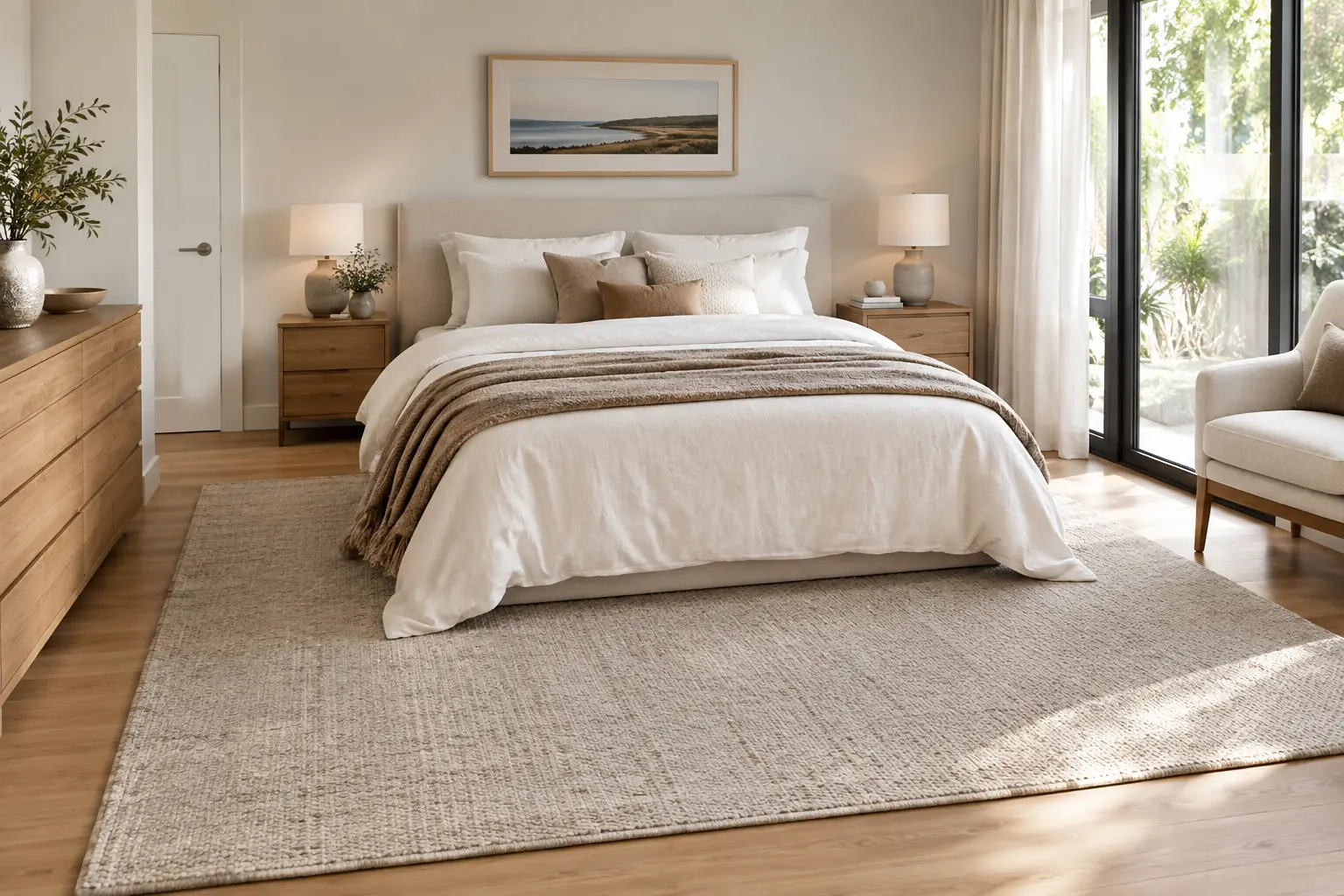
A bedroom can have considered furniture, warm lighting and good linen, yet still feel slightly adrift. Often, the missing element is not more decoration but a rug with enough scale to ground the bed. Searching for the best rug size bedroom layout is really about proportion: giving the bed visual weight, creating softness underfoot and leaving the room feeling composed rather than crowded.
The clearest rule is simple: choose a rug that extends beyond both sides and the foot of the bed. In most bedrooms, a rug that is too small reads like a mat placed in front of furniture. A more generous size connects the bed, bedside tables and the surrounding floor into one calm zone.
Best rug size for a bedroom at a glance
Your bed size is the most useful starting point, but room dimensions and furniture placement matter just as much. These measurements offer a practical guide for common Australian bedroom layouts.
| Bed size | Rug size to consider | Typical placement | | --- | --- | --- | | Single or king single | 160 x 230 cm | Centred beneath the lower two-thirds of the bed, or beside the bed in a compact room | | Double | 160 x 230 cm or 200 x 300 cm | Under the lower two-thirds of the bed, extending past the sides | | Queen | 200 x 300 cm | Under the bed from around the bedside-table line, with generous side and foot coverage | | King | 250 x 350 cm or 300 x 400 cm | Under the bed and, where space allows, the bedside tables |
These are not fixed rules. A queen bed in a narrow apartment bedroom may need a 200 x 300 cm rug placed lower down the bed. A king bed in a broad main bedroom can carry a 300 x 400 cm rug without looking oversized. The right choice is the one that gives the room a balanced border of rug around the bed while preserving clear circulation.
Start with the space around the bed
Before choosing a rug, measure the bed, bedside tables and the clear floor on each side. Ideally, you want at least 45 to 60 cm of rug visible beyond each side of the bed. This is enough for bare feet to land on a soft, textural surface in the morning, without making the rug feel disconnected from the furniture.
At the foot of the bed, aim for 60 to 90 cm of rug beyond the frame. More can be especially effective in a larger room, where the extra length makes the bed feel properly anchored rather than suspended in the middle of a large floor area.
Leave some exposed flooring at the perimeter of the room. In most bedrooms, a border of roughly 20 to 40 cm between the rug and walls helps the layout breathe. This is particularly useful with timber floorboards, polished concrete or tile, where the visible edge of the floor contributes to the room's materiality.
A practical way to test the scale is to mark the proposed rug footprint with painter's tape or sheets of newspaper. Stand in the doorway, walk around the bed and open wardrobes or drawers. The visual answer is often immediate.
The most balanced placement: under the lower two-thirds
For many bedrooms, placing the rug under the lower two-thirds of the bed is the most versatile approach. The rug begins just in front of the bedside tables and runs beneath the bed to extend beyond its foot. It creates a grounded composition while keeping the bedside tables on the hard floor, which can be useful if they are heavy or frequently moved.
This placement suits queen and king beds particularly well. A 200 x 300 cm rug beneath a queen bed often gives a reassuring amount of coverage, especially in standard-sized bedrooms. With a king bed, 250 x 350 cm is usually a more comfortable proportion, provided the room allows it.
There is also a visual benefit. Allowing the rug to begin below the bedside tables gives the bed a clear focal point, while the exposed floor near the wall keeps the room from feeling overly padded or dense.
When to place the whole bed and bedside tables on the rug
A larger rug that sits beneath the entire bed, including bedside tables, can look especially resolved in a generous main bedroom. It creates a broad, unified foundation for the sleeping zone and works well with low, sculptural furniture and restrained warm-neutral palettes.
The trade-off is scale. If the rug is not large enough to extend beyond the bedside tables, it can look pinched. It is better to keep the bedside tables off the rug than force them onto a size that ends too close to their outer edges.
Compact bedrooms need a different solution
Not every bedroom has room for a large rectangular rug, and trying to make one fit can restrict door swings, crowd a wardrobe or cover nearly all the floor. In a smaller room, runners or two matching rugs placed on either side of the bed can provide warmth where it is most felt without competing with the room's architecture.
A pair of 80 x 250 cm runners works well beside a queen or king bed in a narrow room. For a single bed pushed against a wall, one runner along the open side often feels more intentional than a small rug centred beneath the bed. The placement should respond to how you use the room, not simply follow a diagram.
Round rugs can also work in a compact bedroom with curved furniture or a soft, relaxed layout, but they are less effective when the goal is to anchor a large rectangular bed. Their shape is best used to soften an open corner, reading chair or dressing area.
Consider doors, wardrobes and everyday movement
A bedroom rug should support everyday ease. Check that it does not interfere with a hinged door, a sliding robe, under-bed drawers or a bedroom door that opens inward. A rug placed too close to a wardrobe can make an otherwise calm room feel awkward to use.
In homes with pets, children or frequent movement between bedroom and ensuite, a lower-profile rug can be easier to live with. Material and texture also influence the room's visual weight. A tonal wool rug with subtle movement can add depth to a pale bedroom without introducing a busy pattern, while a more dimensional surface creates a soft contrast against smooth timber, linen and painted walls.
Light matters, too. In bright coastal or north-facing rooms, ivory, oat and sand tones can look open and airy, although they may show darker marks more readily in high-contact areas. In urban bedrooms with less natural light, stone, taupe, clay or muted charcoal can bring definition without making the floor feel heavy. Choose a colour that relates to the room's larger surfaces rather than trying to match every piece exactly.
If the bed is off-centre, follow the furniture
Many real bedrooms are not symmetrical. A bed may sit closer to one wall to make room for a cot, a desk, a chest of drawers or a clear path to an ensuite. In these cases, centre the rug on the bed rather than the room itself. The rug's role is to organise the sleeping zone, not correct every architectural irregularity.
If one side of the bed is against a wall, allow more rug to show on the open side and at the foot. This can make the layout feel purposeful and provides the soft landing where it is actually needed. Similarly, in an open-plan loft or oversized main suite, a larger rug helps define the bed as its own quiet zone within a broader space.
A final check before committing
The best bedroom rug is rarely the smallest size that technically fits. If you are deciding between two sizes and the larger option leaves enough floor clearance, it will usually create the more settled result. Rugs are architectural layers in a bedroom: they soften hard finishes, hold the furniture together and make the first steps of the day feel warmer.
Measure carefully, test the outline on the floor and let the room's daily rhythm guide the placement. A well-proportioned rug does not ask for attention, but it gives the whole bedroom a quieter sense of order.