
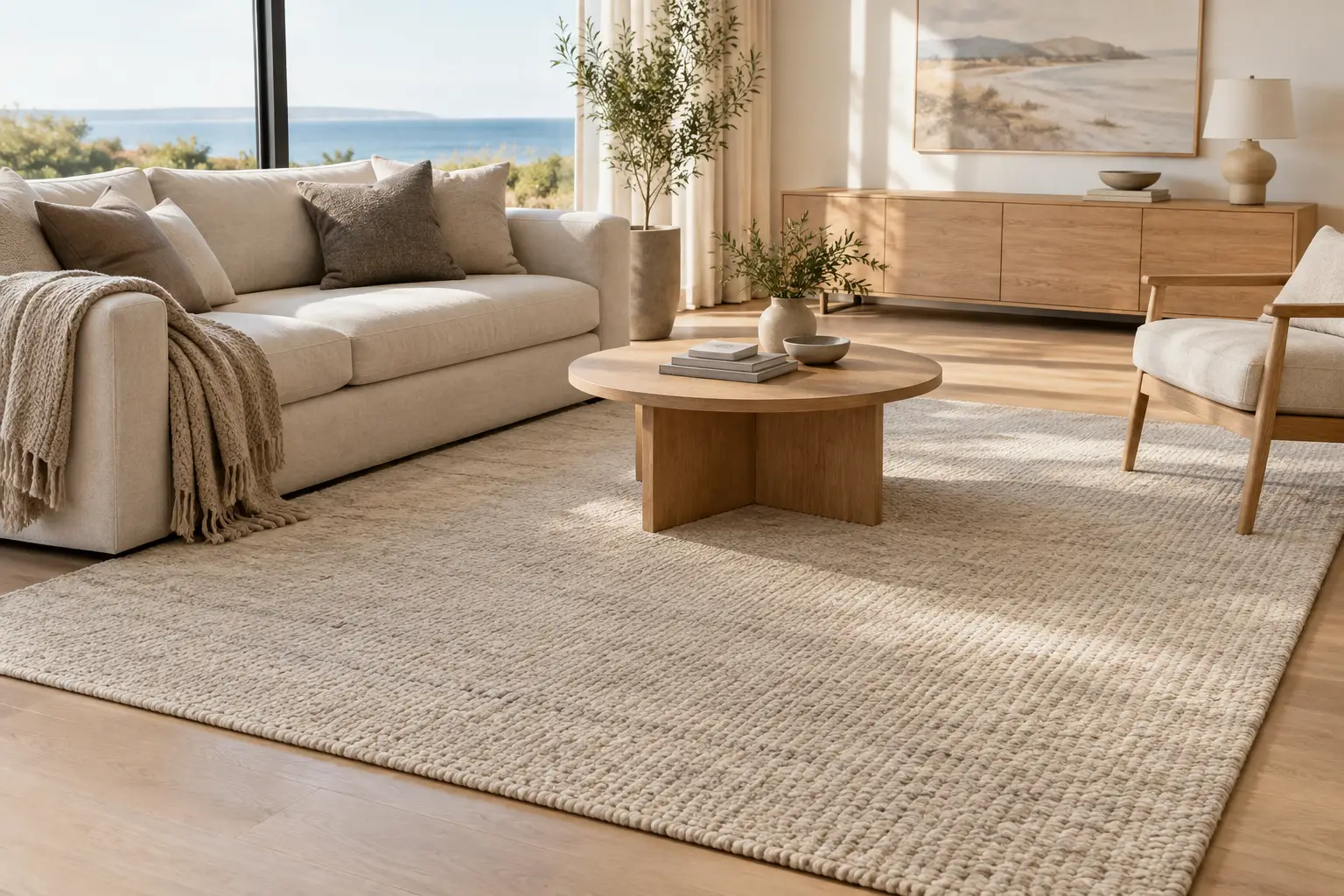
A rug that stops short of the sofa can make an otherwise well-furnished living room feel oddly unsettled. In Australian homes with timber boards, tiled floors and open-plan layouts, contemporary wool rugs Australia homeowners choose often do far more than soften the floor. They set the visual boundary of a room, bring separate furniture pieces into a composed arrangement and add warmth where hard finishes and generous natural light can feel stark.
The right choice is rarely about finding the loudest pattern or the palest neutral. It comes down to proportion, materiality and the way your household actually uses the room. A sculptural wool rug in a restrained warm-neutral palette can make a space feel considered without making it feel precious.
Start with the room, not the rug
Before comparing colours or textures, map the furniture arrangement. A contemporary rug should relate to the footprint of the room's main activity, whether that is conversation in the living area, sleep in the bedroom or gathering around a dining table. Think of it as an architectural layer rather than a small decorative object placed in an empty patch of floor.
In a living room, the most settled arrangement usually allows the front legs of the sofa and occasional chairs to sit on the rug. This visually grounds the seating area and creates a clearer sense of proportion. Where space allows, a larger rug that carries all furniture legs can feel especially calm in a generous room, though it is not essential for every home or budget.
For a standard sofa setting, 200 x 300 cm is often a useful starting point. A more compact apartment living area may suit 160 x 230 cm, provided the rug still reaches beneath the sofa's front legs. In a larger open-plan room, 250 x 350 cm or 300 x 400 cm may be needed to avoid the furniture appearing to float around a too-small central rectangle.
Leave a visible border of flooring around the rug where possible. There is no fixed rule, but around 20 to 40 cm from walls often gives a room enough breathing space. The exception is a particularly narrow room, where working with the architecture rather than forcing an idealised measurement will look more natural.
Contemporary wool rugs in Australia and everyday living
Wool has a tactile presence that works particularly well in interiors built around timber, stone, linen, plaster and upholstered furniture. It can introduce softness without relying on busy pattern, which is why it suits the quiet curves, subtle grids and abstract movement seen in contemporary Australian interiors.
That does not mean every wool rug will behave or feel the same. Pile height, weave, density, colour variation and surface finish all affect its visual weight and day-to-day care. A low, textural surface may feel more tailored beneath a dining setting, while a deeper pile can bring a more enveloping quality to a bedroom or quieter lounge area. The right option depends on the room's traffic, chair movement and how much texture you want underfoot.
Wool can also shed when new, particularly in rugs with a fuller pile. This is generally managed through regular vacuuming with settings appropriate to the rug's construction. Before committing to a rug, review its care guidance and consider practical details such as a suitable underlay, vacuum access and whether the room is likely to receive frequent food, drink or muddy-foot traffic.
A family room, for example, may call for a mid-tone, textural design that does not make every small mark the focal point. A formal sitting room can accommodate a lighter ivory or oat ground more comfortably if it is used less often. Neither choice is more considered - they simply reflect different versions of everyday ease.
Choose colour by looking at undertones
Warm neutrals are often described as easy, but beige, cream, grey and white can sit very differently beside one another. The useful question is not whether a rug matches the sofa exactly. It is whether their undertones belong in the same conversation.
If your home has honey-toned oak, travertine-look tiles, warm white walls or tan leather, look towards oat, sand, taupe, clay and soft brown. These colours reinforce the existing warmth and can make an open-plan room feel more connected. A muted charcoal detail can add definition, particularly where black window frames, dark joinery or aged metal accents are already present.
Cool grey flooring and crisp white walls can be more challenging. Rather than introducing a blue-grey rug by default, consider a balanced stone or mushroom tone with gentle warmth. This helps avoid the flat, chilly effect that can occur when every surface sits on the same cool scale.
Natural light matters as much as the swatch. A coastal home with bright, reflective light may make an ivory rug appear cleaner and lighter than expected. In a south-facing urban apartment, that same rug may read softer or slightly greyer. View samples or imagery in relation to your floor, wall colour and upholstery, and assess them at different times of day before deciding.
Use texture to add depth without visual noise
A contemporary interior does not need to be plain. It needs a hierarchy. When the sofa, artwork and joinery are already expressive, a rug with broad quiet curves, a low-contrast border or a finely textured surface can provide depth without competing for attention.
In a calmer room, a rug can carry a little more visual interest. Consider tonal folds, irregular linear movement or a sculptural cut-and-loop effect that changes gently with the light. These details are often more liveable than high-contrast motifs because they reward a closer look while allowing other elements in the room to settle.
Pay attention to contrast. A pale rug against dark floorboards creates a defined zone and can make the rug feel visually prominent. A mid-tone rug closer to the floor colour produces a quieter transition. Neither approach is inherently better. Choose the first when the room needs structure, and the second when you want furniture, art or a view to remain the strongest feature.
Give open-plan spaces clearer boundaries
Open-plan homes benefit from rugs that describe each zone without creating a series of disconnected islands. In a combined living and dining area, use one rug beneath the lounge setting and another beneath the table only if each has enough scale to feel intentional.
For the dining area, measure the table at its fullest everyday size, then allow approximately 60 to 75 cm beyond each side. This gives dining chairs room to remain on the rug when pulled back. A 180 cm-long table, for instance, will often need a rug at least 300 cm long. If that footprint crowds a nearby kitchen island or walkway, a rug may not be the practical choice for that zone.
Rugs do not need to match across an open plan, but they should share something - perhaps a warm-neutral base, a similar depth of colour or a related textural character. This is enough to make the spaces feel connected while allowing the living room and dining area to have their own purpose.
Keep care realistic
A thoughtful rug choice includes a realistic care plan. Vacuum regularly according to the product guidance, attend to spills promptly by blotting rather than rubbing, and avoid introducing harsh cleaning methods without checking the recommended instructions. Rotation from time to time can help distribute the effects of light and foot traffic more evenly.
In homes with sliding doors, outdoor entertaining and children moving between garden and living room, placement matters. A wool rug can still be a considered choice, but it may be wiser to position it within the seating zone rather than directly at the threshold where wet feet, sand or frequent food spills are most likely.
The most successful rug is not the one that asks a household to behave differently. It is the one whose scale, colour and texture support the way the room is already lived in.
When you are ready to narrow the options, begin with a floor plan and a few honest notes about light, traffic and the colours already in the room. From there, a rug becomes less of a finishing touch and more of the element that lets the whole space feel grounded.