
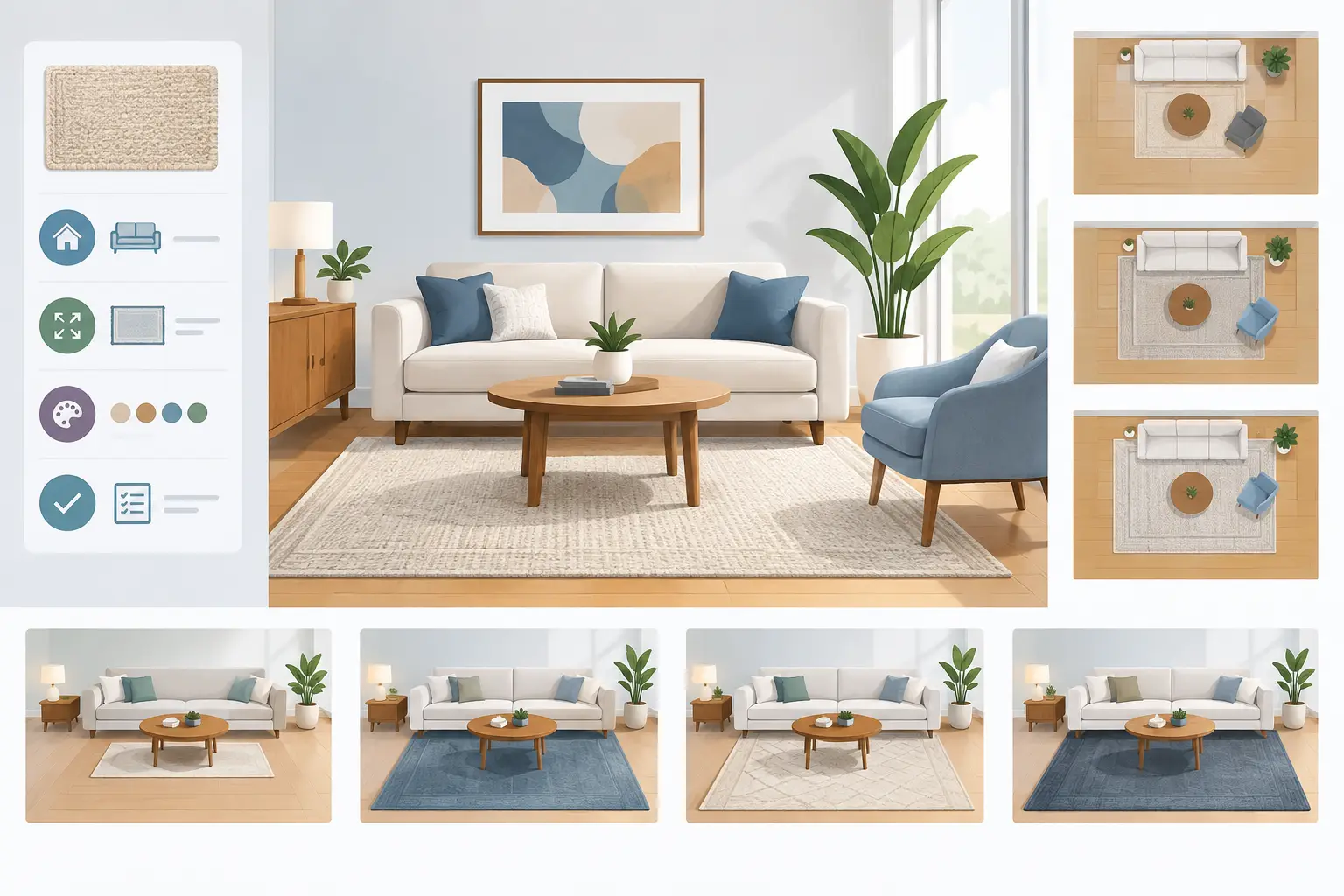
A rug can make a room feel settled, or leave it feeling strangely unfinished. The difference is rarely the colour alone. Knowing how to choose rug size means reading the room as a whole: where furniture sits, how people move through it, and how much quiet floor space should remain around the edges.
For contemporary Australian homes, the most successful rug is usually more generous than expected. It gives furniture a shared ground plane, softens hard surfaces and brings a sense of proportion to open-plan rooms. A rug that is too small can make even well-chosen pieces appear disconnected. One with the right scale creates structure without asking for attention.
Begin with the room, not the rug
Before looking at designs, measure the usable furniture zone. This is not always the full dimension of the room. In a living area, it is the arrangement formed by the sofa, chairs and coffee table. In a dining room, it is the space needed for chairs to move back comfortably. In a bedroom, it is the area where bare feet meet the floor each morning.
Mark the proposed rug with painter's tape, newspaper or a folded sheet. Walk around it. Open drawers, pull out dining chairs and notice whether the boundaries feel considered. This simple exercise is particularly useful in apartments, where every centimetre has a visual effect.
As a general guide, allow 20 to 40 centimetres of visible flooring between the rug and surrounding walls. Larger rooms can carry a broader border, while compact rooms may need less. The aim is not a rigid measurement. It is a calm relationship between floor, furniture and architecture.
How to choose rug size in a living room
The living room is where scale matters most. A rug should connect the seating arrangement rather than sit beneath the coffee table as an isolated rectangle. If the front legs of every major seat rest on the rug, the room will usually feel coherent. Where space allows, placing all furniture legs on the rug creates an even more grounded, generous composition.
For a standard sofa-and-armchair arrangement, 200 x 300 cm is often a useful starting point. In a larger lounge or open-plan home, 250 x 350 cm may be the better proportion. A 160 x 230 cm rug can work in a compact sitting area, but it needs to reach beneath the front legs of the sofa rather than float in the centre.
There are three practical placement approaches:
- All legs on: Best for larger rooms and generous seating zones. The rug extends beyond the sofa and chairs, creating a composed foundation.
- Front legs on: A versatile choice for most homes. The rug sits beneath the sofa's front legs and reaches under the front edge of occasional chairs.
- Furniture off: Suitable only for a small, clearly defined nook where the rug is still large enough to relate to the coffee table and seating.
A larger rug is not simply a matter of visual luxury. It also helps an open-plan room read as distinct zones. Beneath a low-profile sofa, a wool rug with sculptural texture can hold the seating area in place while allowing the wider room to remain airy.
Consider the coffee table and circulation
Leave approximately 35 to 45 centimetres between the sofa and coffee table. This is close enough for a tray or book, but leaves an easy path through the room. The coffee table should sit fully on the rug, with enough rug visible around it to make the arrangement feel intentional.
If one side of a living room is a main walkway, do not force the rug into symmetry. It is better to preserve clear circulation than to centre every element precisely. Rooms are lived in, and a good layout acknowledges that.
Choose dining rug dimensions for moving chairs
A dining rug needs to work when the table is in use, not only when the chairs are tucked in. Measure the table, then add at least 60 centimetres on every side. This allows dining chairs to remain on the rug when pulled back, avoiding the awkward catch between pile and floor.
For a six-seat rectangular table, a 200 x 300 cm rug is often appropriate, though a longer table may need 250 x 350 cm. Round tables suit round rugs beautifully when the room has enough space, but a square or rectangular rug can be more practical if the dining zone sits within an open-plan layout.
Texture deserves consideration here. A low, dense pile or a flatter woven surface generally allows chairs to move with less resistance. Deep sculptural pile is inviting underfoot, but may be better suited to a living room or bedroom where chairs are not repeatedly sliding across it.
Let the bed set the rug placement
In bedrooms, a rug should bring softness to the sides and foot of the bed, rather than disappear beneath it. For a queen bed, 200 x 300 cm is a generous and reliable option when positioned horizontally, with the rug beginning around the bedside-table line and extending beyond the foot of the bed.
A king bed often needs 250 x 350 cm to maintain the same sense of proportion. This size gives enough coverage at both sides, particularly in rooms with wide bedframes or substantial bedside tables. If the room is narrower, consider placing the rug perpendicular to the bed so it extends across the width and offers softness where it is most needed.
Smaller rooms can benefit from runners on either side of the bed, especially where built-in wardrobes or a tight furniture plan make a larger rug impractical. This is not a compromise when done deliberately. Two tonal runners can frame the bed with a clean, architectural rhythm.
Include or exclude bedside tables?
There is no single rule. Placing the rug beneath the lower two-thirds of the bed, with bedside tables left on the floor, often looks balanced and keeps the rug visually open. Taking the rug under the entire bed and tables can suit a larger bedroom, particularly where a broad rug helps anchor the furniture against high ceilings or expansive floorboards.
The deciding factor is the amount of rug visible. If only a narrow strip will show at the sides, size up or choose a different placement. The surface should feel present, not incidental.
Open-plan rooms need clear boundaries
In an open-plan home, rugs quietly establish function. A living rug can define the lounge without requiring a wall or divider. A dining rug can give the table its own centre of gravity. Their sizes do not need to match, but they should feel related through palette, texture or proportion.
Avoid treating every zone as identical. A large living area may need a substantial rug with broad, quiet curves or tonal movement, while the dining zone calls for a more restrained surface that supports everyday use. What matters is that each rug is large enough to hold its furniture group.
Where two rugs sit close together, leave a visible channel of flooring between them. This pause helps each zone retain its own shape. In smaller open-plan spaces, one generous rug may be more effective than several smaller ones competing for attention.
Use shape with intention
Rectangular rugs suit most furniture layouts because they echo the lines of sofas, beds and dining tables. They are also easiest to place in long Australian living rooms and apartment interiors. A round rug can soften a square room, highlight a circular dining table or bring relief to an arrangement with many straight edges.
Organic forms work best when there is enough negative space around them. Their outline should be visible, not obscured by furniture. In a restrained interior, a subtle curved edge can introduce movement without adding pattern or visual noise.
Account for doors, piles and everyday use
Measure door clearances before committing to a rug, particularly near balconies, entries and bedroom doors. A lower profile may be necessary where doors swing across the floor. Underlay can add a small amount of height, so include it in your consideration.
Natural wool is well suited to everyday living: tactile, resilient and forgiving in rooms that see regular use. Its texture can change the perceived scale of a rug, too. A deep, dimensional surface has more visual presence than a flat weave in the same size. In a compact room, that may be a welcome layer of warmth; in a room already rich with texture, a quieter construction may allow the proportions to speak.
When deciding between two sizes, choose the larger one if the room and budget allow. The right rug does more than fill an area of floor. It gives the room a measured place to gather, rest and be lived in.