
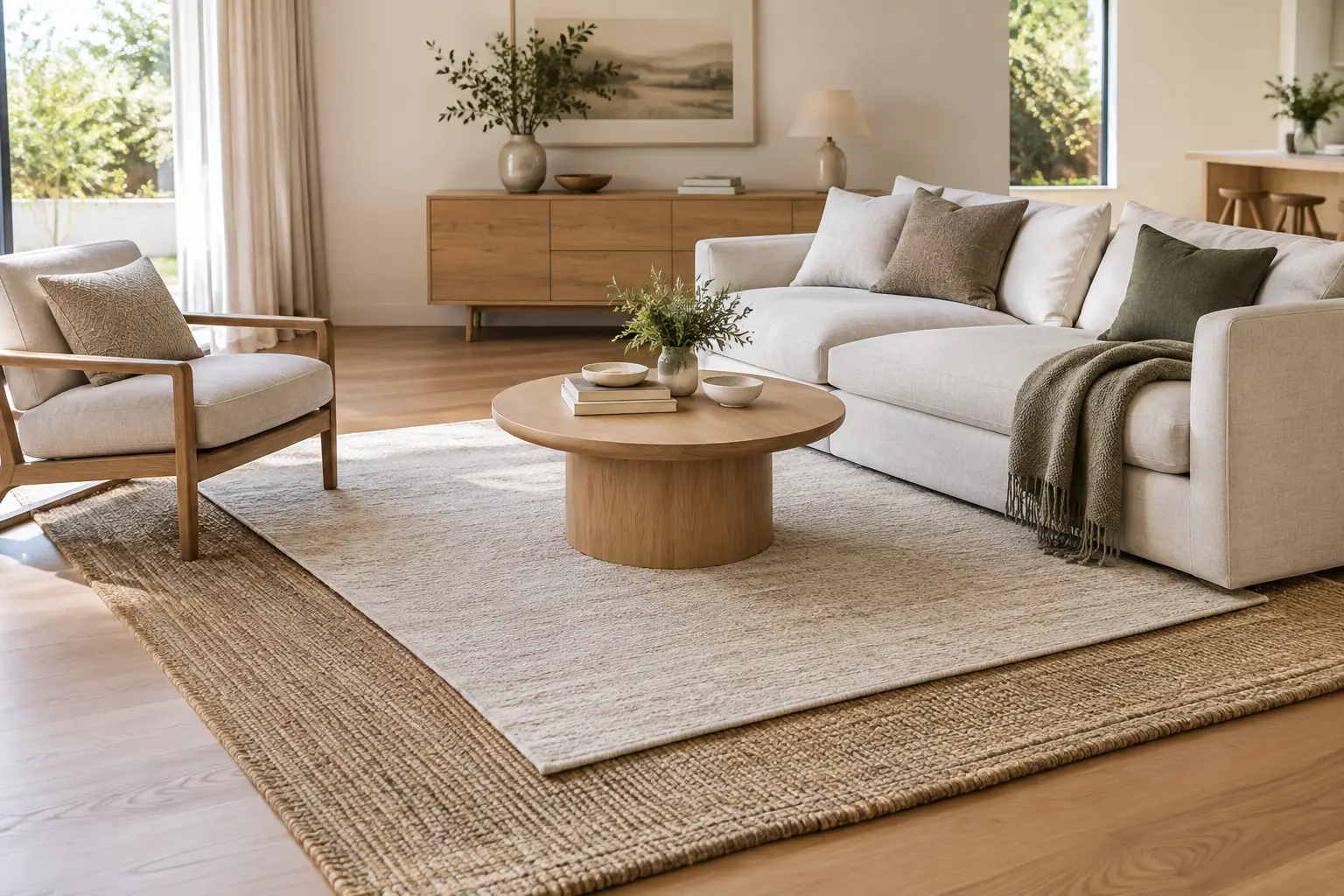
A single rug can ground a room. Two can add a more lived-in sense of depth - but only when each has a clear role. Knowing how to layer rugs is less about adding pattern or filling empty floor space, and more about proportion, materiality and visual weight. Done well, layered rugs soften timber or tiled floors, make a seating area feel more settled and bring warmth to a room without making it feel busy.
The simplest approach is to begin with a larger, quieter base rug, then place a smaller, more textural or expressive rug over it. The base establishes the room’s boundaries; the top layer creates focus. Think of it as composing a room from the floor up, rather than adding a decorative extra at the end.
How to layer rugs with a clear sense of proportion
The lower rug should be large enough to anchor the furniture arrangement on its own. In a living room, this usually means it sits beneath at least the front legs of the sofa and chairs, extending beyond the outside edges of the seating area. When the base rug is too small, adding another rug tends to emphasise the lack of scale rather than solve it.
For many Australian living rooms, a 200 x 300 cm or 250 x 350 cm base rug gives a more grounded result than a smaller piece placed in the centre like an island. Leave a visible border around the top rug, usually around 20 to 40 cm on each side. This reveals the underlying layer and makes the pairing feel intentional.
The top rug does not need to be perfectly centred. In fact, a slight shift can look more natural in an asymmetrical room or beside a sectional sofa. What matters is that it still relates to the furniture. It might sit beneath the coffee table, align with the sofa’s inner edge, or favour the armchair zone where people naturally gather.
In a compact apartment, use restraint. A generous base rug with a smaller overlay can work, but avoid placing several small rugs close together. The floor needs moments of quiet, especially where rooms flow into one another.
Start with the base rug
The base layer should carry the greater visual area, so choose something calm enough to live with. Flatwoven or low-profile rugs often work well here because they sit neatly under furniture and allow the upper layer to remain the feature. A softly textured design in oat, sand, stone, warm grey or muted charcoal can bring definition without competing with the rest of the room.
A base rug with a subtle grid, border or tonal movement can also be effective. The key is low contrast. If its pattern reads clearly from across the room, pair it with an especially restrained top layer.
Consider the room’s fixed finishes before choosing colour. Pale oak floors and creamy walls often suit warm-neutral rugs with a little brown or clay in the mix, while cooler tiles may benefit from taupe, mushroom or charcoal undertones. In a coastal home with strong daylight, texture can do more work than colour. In a darker terrace or character home, a lighter base layer can stop the floor plane from feeling heavy.
Add contrast through texture, not noise
The upper rug is where layering becomes tactile. It might have a deeper pile, a sculptural surface, broad quiet curves or a subtle abstract motif. Rather than pairing two bold patterns, create contrast through the way each rug catches light and feels underfoot.
A simple combination might be a large, low-profile ivory rug beneath a smaller wool rug with soft, folded lines in sand and clay. Another could pair a grounded taupe base with a top layer in muted brown and charcoal. These combinations feel composed because the colours speak to one another, even when the textures differ.
Pattern can work, but it needs breathing room. If your sofa has a pronounced weave, your cushions are patterned or the room includes veined stone, the top rug is better kept tonal. Conversely, a quiet linen sofa, plain curtains and simple timber furniture can support a rug with more movement.
Avoid treating contrast as a rule in itself. A high-contrast black-and-white layer may suit a graphic, urban interior, but it can feel disconnected in a warm, relaxed room built around natural timber and soft upholstery. Layering works best when the rugs belong to the same overall palette, rather than when they compete for attention.
Layer rugs in a living room
In a living room, the furniture arrangement should lead. Place the larger rug first, then position the upper rug where it strengthens the conversation zone. Under a coffee table is often the most natural location, provided the rug reaches towards the sofa and chairs rather than sitting as a small rectangle in the middle.
For a modular sofa, let the base layer follow the full footprint of the seating arrangement. The top rug can then soften the central area, particularly if the sofa’s shape feels broad or angular. A rounded or organically shaped upper rug can introduce movement against straight-lined joinery and rectangular furniture.
If the room opens onto a dining area or kitchen, use the layered living room rug as a boundary. It creates a visual pause between zones without closing off the open plan. Keep the dining rug separate and generously sized enough that dining chairs remain on it when pulled back. Overlapping rugs between these two zones usually makes the layout feel less clear.
Use layering to make bedrooms feel more settled
Layering can be particularly useful in bedrooms where a large rug may not be practical or necessary. Place a generous, quiet rug beneath the lower two-thirds of the bed, then introduce a smaller, softer rug at the foot. This adds texture where it is most visible and keeps the bedside area grounded.
Alternatively, position a narrow runner across the foot of the bed over a larger base rug. This works well in bedrooms with upholstered bedheads, plain bedding and minimal furniture, where the floor can carry a little more visual interest.
Be careful with a thick top layer near doors, drawers or wardrobes. Check that it does not interfere with movement, and avoid a placement that leaves an awkward sliver of rug beside the bed. In smaller bedrooms, one well-sized rug is often the calmer choice.
Let shape support the room
Rectangular rugs are dependable because they echo sofas, beds and dining tables. But a round, oval or freeform rug can be useful as the upper layer when a room feels too linear. A curved shape beneath a circular coffee table, for example, can soften a square living room without adding another strong colour.
Scale still matters. A small round rug on top of a large rectangle can look considered when it is substantial enough to relate to the coffee table and nearby seating. If it is too small, it reads as a mat rather than a purposeful layer.
In homes with children, pets or frequent indoor-outdoor traffic, placement becomes as practical as it is visual. Keep layered edges away from main walking paths where possible. A rug underlay can help both layers sit more securely and reduce shifting on smooth flooring. Choose a combination that suits the level of everyday ease you need, rather than building a scheme that only works when the room is untouched.
Common mistakes when layering rugs
Most unsuccessful pairings come down to scale, not taste. Two rugs of nearly identical size can look accidental because neither clearly acts as the base. Similarly, two high-pile rugs may create too much bulk and make coffee tables or chairs feel unstable.
It is also easy to introduce too many colours at floor level. If the base rug, top rug, cushions and artwork all make separate statements, the room loses its visual calm. Pull one or two tones from the upper rug into the cushions, a throw or ceramics, then allow the rest of the room to stay relatively quiet.
Finally, do not feel obliged to layer everywhere. A dining room usually benefits more from one substantial rug, while a narrow hallway may only need a runner. Layering earns its place when it adds warmth, clearer zoning or a more balanced composition.
Before committing, lay the proposed dimensions out with painter’s tape or sheets on the floor. Seeing the border, furniture relationship and walking space at full scale is often the clearest way to decide whether a second layer will make the room feel richer or simply more crowded. The right pairing should feel settled from the doorway and comfortable in the everyday moments that follow.