
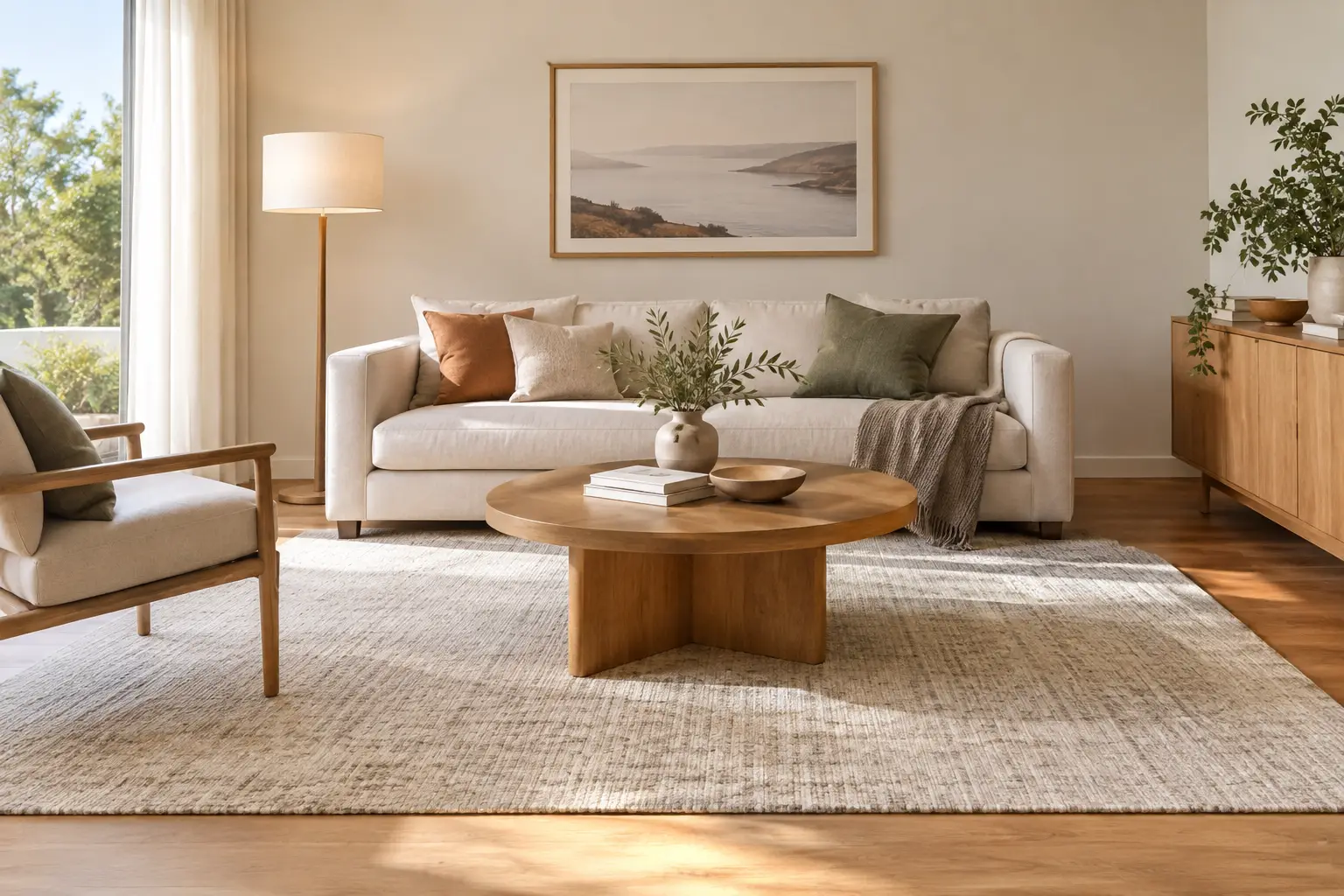
A rug can look entirely different once the lamps are switched on. Its tonal shifts become clearer, a textural surface gains depth, and a quiet border or sculptural curve can either settle into the room or compete for attention. Thoughtful lamp selection with a rug is less about finding matching objects and more about balancing light, scale and visual weight.
Start with the rug because it usually covers the largest visual plane below eye level. It anchors the seating area, establishes a colour direction and changes how furniture is read against timber, tile or concrete floors. Lamps should support that foundation, bringing warmth and rhythm to the room without making the composition feel overworked.
Begin with the rug's visual language
Before choosing a lamp base or shade, look closely at what the rug is already doing. A rug with broad, quiet curves or abstract movement often suits lighting with clean silhouettes: a softly rounded ceramic base, a slender floor lamp or an understated linen shade. The connection does not need to be literal. Repeating one quality - softness, linearity, earthiness or sculptural form - is usually enough.
A more textural rug has its own visual presence, particularly in afternoon light across an Australian living room. Pairing it with a highly decorative lamp may create too many focal points in one corner. In this case, a simple base with a natural-looking shade lets the texture remain the feature.
Conversely, a restrained, low-contrast rug can carry a lamp with more shape. A pleated shade, a rounded stone-coloured base or a dark timber detail can add a useful point of interest while preserving the room's calm. Think in terms of contrast, not coordination: one element can be expressive while the other holds the room together.
Match the lamp's scale to the rug zone
The rug defines the zone. The lamp needs to feel proportionate to that zone, rather than to the room in isolation. In a compact apartment sitting area, a large arched floor lamp may visually outweigh a 160 x 230 cm rug and make the furniture grouping feel crowded. A smaller table lamp on a side table, or a floor lamp with a fine profile, may give the same evening ambience with less visual bulk.
In a larger living room, particularly one with a 250 x 350 cm rug that holds a sofa and occasional chairs, undersized lamps can disappear. Taller floor lamps at the outer edges of the rug help frame the seating arrangement and give the area a settled, intentional boundary after dark.
As a practical guide, the lamps in a seating area should relate to the furniture sitting on or around the rug. A table lamp should generally sit at a height where the lower edge of the shade is near seated eye level, so the bulb is not exposed when someone is on the sofa. Floor lamps can sit slightly taller, but their shade should not loom over the people using the space.
Consider footprint as well as height. A wide tripod base needs clear floor area and may be awkward where the rug edge meets a busy walkway. A weighted, narrow base often works better beside an armchair or in the gap between a sofa and wall. Placement should feel composed, but it must also allow for everyday movement through the room.
Let the furniture arrangement lead
If the front legs of the sofa and chairs sit on the rug, place lamps just beyond the rug's corners or alongside the seating rather than directly in the middle of its open area. This keeps the centre clear and preserves the sense of generosity created by the rug.
Where an occasional chair sits fully on a rug, a floor lamp behind or beside it can form a quiet reading corner. The rug then does more than soften the floor: it gives the lamp, chair and side table a shared purpose. In an open-plan home, these smaller pools of light are particularly helpful for defining zones once overhead lights are off.
Choose colour by undertone, not exact matching
A lamp does not need to be the same colour as the rug. Exact matching can make a room feel flat, especially when both pieces are warm-neutral. Instead, look for compatible undertones.
An ivory or oat rug with warmth in its base works naturally with aged white, sand, clay, pale timber and soft brown lamp finishes. A cooler grey-white lamp can look unexpectedly sharp against it, even if both appear neutral when viewed separately. Similarly, a taupe or muted charcoal rug may sit well with deep brown, blackened metal or smoked ceramic, provided the rest of the room carries a few similarly grounded notes.
For rugs with gentle tonal variation, choose a lamp base that picks up one of the quieter colours rather than the most obvious one. If a rug moves between stone, mushroom and pale brown, a muted brown base can make the palette feel more resolved. A shade in flax, parchment or warm white will diffuse the connection rather than making it feel staged.
This matters in homes with abundant natural light. Coastal rooms, rooms with large north-facing windows and open-plan new builds can make cool whites look bluer and warm neutrals look lighter during the day. View a lamp sample or finish near the rug at different times if possible. Evening lamplight will change the relationship again.
Use shades to control mood and contrast
The shade is often the most visible part of a lamp once it is lit. It determines whether the light reads as soft and ambient or crisp and directional, and it adds a distinct block of colour above the rug.
Linen-look, fabric and parchment-toned shades often work well with wool rugs because they bring a similarly quiet, tactile quality. This is not a rule. A smooth paper or painted metal shade can introduce welcome contrast beside a looped or deeply textural surface. The question is whether the contrast feels deliberate and repeated elsewhere, perhaps in a metal side table, framed artwork or kitchen hardware visible from the living zone.
White shades are useful, though bright white can feel disconnected from a palette built around oat, cream and timber. Softer white, natural linen and pale biscuit tones usually create a gentler transition. If the rug is pale and the walls are also light, a darker lamp base can provide needed definition without making the room heavy.
For practical evening use, consider where light falls. A floor lamp with an opaque shade may create a more contained pool of light beside an armchair. A translucent shade can provide a broader glow for conversation. Neither is automatically better. A media room may need reduced glare, while a family living room used for reading, homework and quiet evenings may benefit from layered light at several heights.
Build layers instead of relying on one statement lamp
A single dramatic lamp can be effective, but it rarely carries a living room on its own. Rugs create atmosphere from the ground up; lighting works best when it does the same from more than one level. Combine a floor lamp with a smaller table lamp, or use a table lamp alongside a pendant or wall light where available.
The lamps do not have to match. In fact, matching pairs can feel formal in a relaxed contemporary home. What matters is a shared thread: similar shade tones, compatible materials or a repeated curve. One lamp might have a rounded ceramic base while another has a finer metal stem, provided both use warm, softly diffused shades.
In an open-plan space, use the rug to decide where this layered lighting belongs. The dining area may have its own overhead light, while the living area benefits from lamps that bring visual warmth at the perimeter of its rug. This distinction makes one large room feel more liveable without adding screens or extra furniture.
Avoid the common balance problems
The most common issue is treating the rug and lamp as separate purchases. A lamp chosen for its shape alone can feel too glossy, too dark or too visually busy once it sits beside a detailed rug. Bring together photos, swatches or samples before deciding, and assess them against the sofa, flooring and walls as well.
Another is placing every lamp symmetrically. Symmetry can be useful with a formal sofa arrangement, but many homes benefit from a little asymmetry: a floor lamp by one end of the sofa, a table lamp near an occasional chair, and open space on the other side. The rug keeps the grouping grounded, so the lighting can feel relaxed rather than rigid.
Finally, do not overlook practical access. Cords need a considered path along a wall or beneath furniture, not across the part of the rug used as a walkway. A lamp that looks right but interrupts daily movement will quickly feel less considered.
The strongest pairings often feel almost accidental: the warm wash of a shade over a quiet rug, a rounded base echoing a soft edge, or a darker lamp giving shape to a pale seating zone. Choose the rug as the grounding layer, then let the lamps bring evening depth to the life that happens around it.