
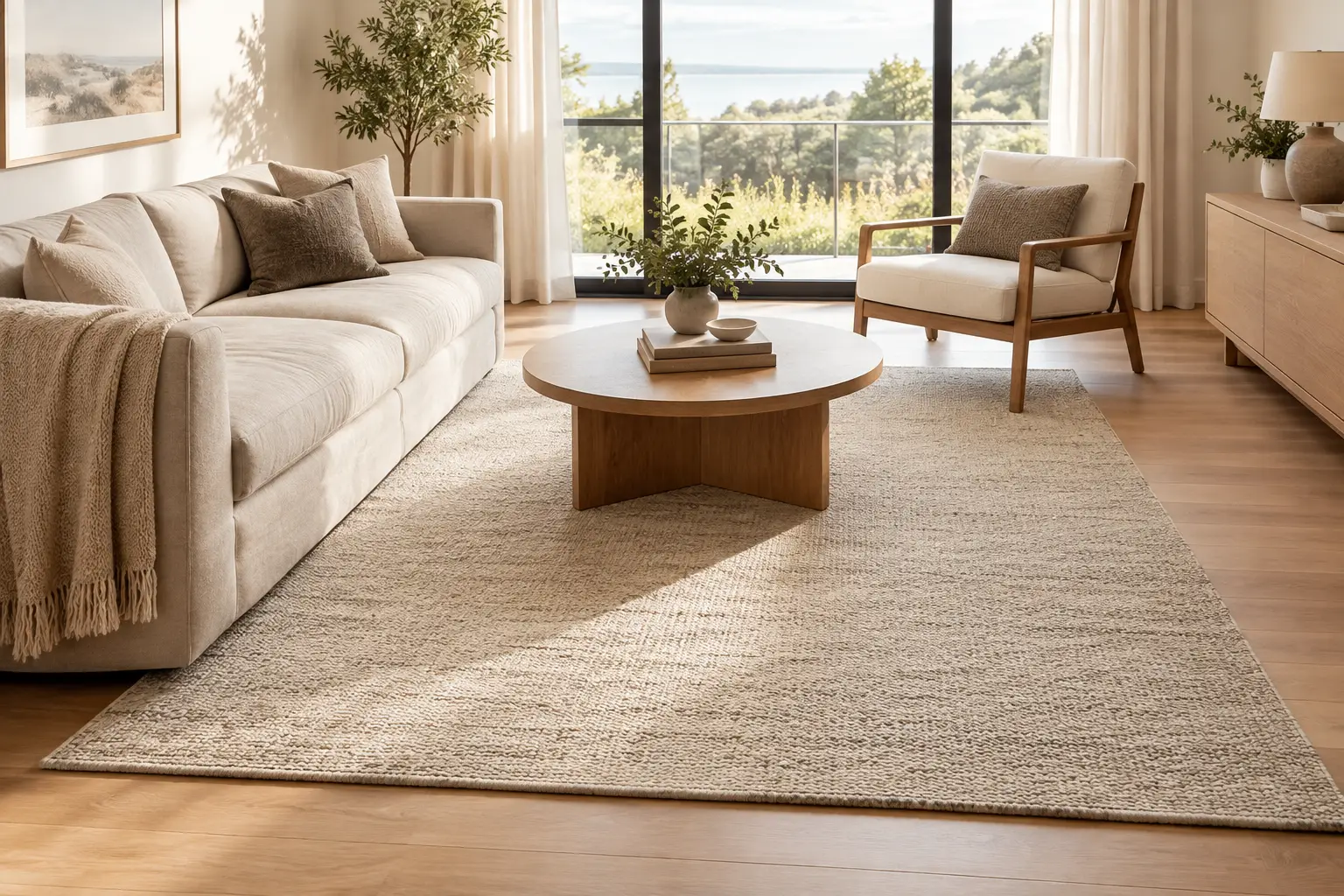
A rug that is too small can make an otherwise resolved living room feel oddly temporary. It leaves the sofa, chairs and coffee table floating as separate pieces rather than one composed setting. This living room rug size guide begins with a simple principle: choose a rug to define the furniture arrangement, not merely to fill the bare floor beneath a coffee table.
In contemporary Australian homes, where open-plan rooms, generous glazing and hard flooring are common, a rug often does more than add softness. It creates a quiet boundary, absorbs some of the visual spread of a large room and gives everyday seating a sense of centre.
Start with the seating zone, not the room
Measure the area occupied by your sofa, occasional chairs and coffee table before considering the room's overall dimensions. The rug should feel proportionate to this grouping, with enough surface around it to establish a clear, grounded zone.
A useful starting point is to allow the rug to extend at least 15-30 cm beyond either side of the sofa where possible. This gives the arrangement breadth and prevents the sofa from appearing oversized in relation to the rug. In a larger room, more extension will generally look better.
Leave a border of exposed flooring between the rug and the walls. Around 20-45 cm is often comfortable, though this depends on the scale of the room. In a compact apartment living area, a narrower border can make the rug feel generous without crowding the perimeter. In a larger house, a more substantial margin preserves a sense of air and proportion.
Masking tape is one of the most reliable planning tools. Mark the proposed rug dimensions on the floor, then live with the outline for a day or two. Walk around it, open drawers, check door swings and notice where the edges sit in relation to circulation paths. A measurement on paper can appear convincing; an outline at full scale reveals how the room will actually work.
Living room rug size guide: the three placements
There is no single correct placement, but most living rooms suit one of three approaches. The right choice depends on the room's scale, the furniture footprint and whether the living area needs to feel contained or expansive.
All furniture legs on the rug
This is the most resolved option for a generous living room. The sofa, chairs and coffee table all sit fully on the rug, leaving a visible band of rug around each piece. It works especially well with modular sofas, paired armchairs and rooms where the seating area occupies a central position rather than sitting tightly against a wall.
For this arrangement, 300 x 400 cm is often a useful starting point, while 350 x 450 cm may suit a substantial lounge or open-plan home. These larger sizes bring composure to broad floor areas, though they require enough surrounding floor to avoid appearing wall-to-wall.
The trade-off is practical rather than aesthetic. A large wool rug is a significant piece to manoeuvre, and its dimensions should be checked against lifts, stairwells and access points before delivery.
Front legs on the rug
For many Australian living rooms, this is the most adaptable placement. The front legs of the sofa and chairs rest on the rug, while the rear legs remain on the floor. The result is connected and intentional, without requiring the footprint of a very large rug.
A 250 x 350 cm rug often works well for a standard three-seat sofa with one or two chairs. In a narrower room, 200 x 300 cm can provide a convincing anchor, provided it reaches beneath the sofa's front feet and extends towards the chairs. The coffee table should sit entirely on the rug, with enough clear surface around it to prevent the composition from feeling crowded.
This placement is particularly useful in rental homes and apartments, where room dimensions may limit your choices. It offers visual continuity while leaving more timber, tile or polished concrete visible at the edges.
The floating rug
A floating rug sits beneath the coffee table only, without reaching the seating. It is best reserved for genuinely compact rooms, or for layouts where the furniture is already closely grouped and a larger rug would interrupt a walkway.
The risk is choosing a rug that is too modest. A small 160 x 230 cm rug beneath a long sofa can read as an island rather than an anchor. If this is the only workable layout, select the largest size that maintains clear access around the seating. In most cases, 200 x 300 cm will feel more generous and better balanced than a smaller option.
Choose dimensions that suit your furniture
Rug sizing becomes easier when you begin with the sofa. A standard three-seat sofa is often around 220-250 cm wide, while a chaise or modular configuration may reach 280 cm or more. A rug should not be noticeably narrower than the sofa unless the room is intentionally compact and tightly arranged.
For a sofa around 220 cm wide, a 200 x 300 cm rug may work in a smaller room, particularly with front legs on the rug. A 250 x 350 cm format offers more breathing room and better accommodates armchairs. For an L-shaped sofa, consider the full outer footprint rather than only the longest edge. The rug should support the entire conversation area, including the return of the chaise or the chair opposite it.
Coffee table proportions matter as well. Keep approximately 30-45 cm between the sofa and coffee table for comfortable movement, and ensure the table does not consume most of the rug's visible surface. A low, sculptural table can sit comfortably within a larger expanse of textured wool, allowing both forms to register clearly.
Shape can change the room's rhythm
Rectangular rugs are the natural choice for most linear sofa arrangements. They echo the architecture of long rooms, align easily with cabinetry and create a calm framework beneath a sectional or straight sofa.
A round rug can soften a room built from strong horizontal and vertical lines. It can be effective beneath a curved sofa, a circular coffee table or a compact arrangement of occasional chairs. The diameter needs to be generous enough to relate to the seating, rather than appearing as a small decorative disc at the centre.
Organic or softly irregular forms introduce another kind of spatial effect. Broad, quiet curves can relax a rectilinear room and give an open-plan setting a more informal boundary. Because the edges are less predictable, trace the shape at scale before committing. The widest points should still support the furniture layout in the same way a rectangular rug would.
Account for open-plan living
In an open-plan home, the rug should give the living area a distinct identity without making it feel cut off from the dining or kitchen zone. Position it so that it follows the orientation of the seating, not necessarily the grid of the entire room.
A larger rug is usually more successful here. It allows the lounge to hold its own beside a dining table, island bench and expansive floor finish. If the living area sits behind a sofa, allow the rug to extend under the sofa or sufficiently beyond its front legs. This creates definition from every approach, including the view from the kitchen.
Consider sightlines too. A restrained warm-neutral palette can bridge adjacent zones without competing with joinery, artwork or outdoor greenery. Tonal texture adds depth at floor level while allowing the architecture to remain legible.
Let material support the scale
The larger the rug, the more visible its texture becomes. This is where material choice influences the room beyond colour alone. Wool has a natural density and softness that helps a large rug feel settled rather than flat. Its tactile surface can temper hard flooring and the clean-lined furniture common in contemporary interiors.
In a family living room, look for a construction and pile that suit the pace of daily use. A low to medium pile is generally easier to live with beneath coffee tables and in pathways, while a more textural finish can bring warmth to a quieter sitting room. A rug pad can improve underfoot comfort, reduce movement and help protect both the rug and floor beneath.
Do not select a smaller rug simply because it feels safer. A correctly scaled rug often makes a room appear more considered, even when the furniture itself is modest. It gives the eye one calm, continuous plane on which the rest of the room can settle.
Before making a final choice, return to the taped outline and view it from the doorway, sofa and adjoining spaces. The right rug size will not call attention to its calculation. It will make the room feel as though its proportions were always meant to be there.