
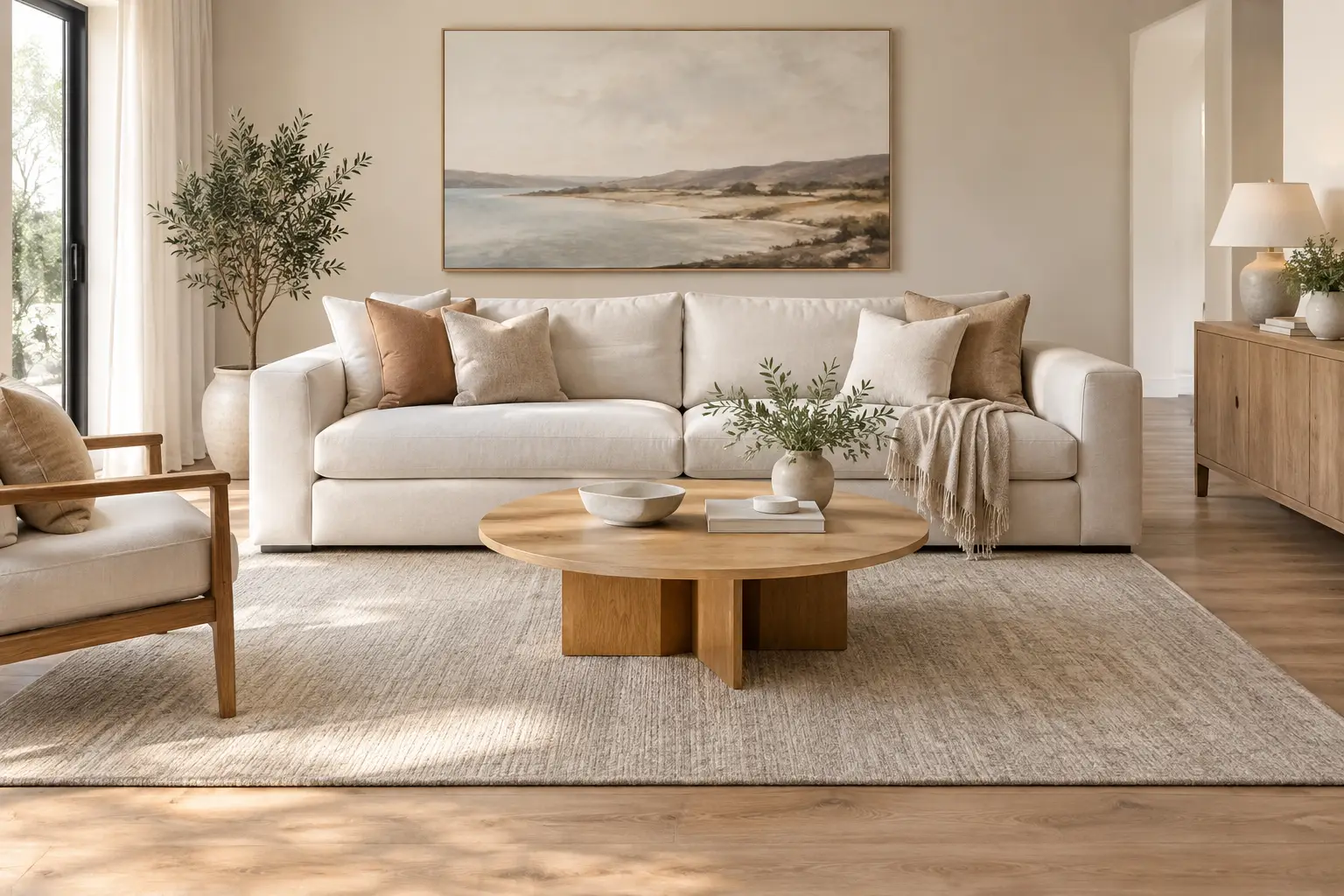
A rug that stops just short of the sofa can make an otherwise considered room feel oddly disconnected. Good rug placement under sofa creates a shared ground for the seating area: the sofa, chairs and coffee table read as one composed arrangement rather than separate pieces set around the room.
The simplest rule is also the most useful: place at least the front legs of your sofa on the rug. From there, the right decision depends on the room’s proportions, how the furniture is arranged and how much open floor you want to retain. A rug should give a living room structure, not merely fill an empty patch of floor.
Should a rug sit under a sofa?
In most living rooms, yes. Letting the rug run beneath the sofa’s front legs creates a clear connection between the seating and the floor plane beneath it. It gives the arrangement visual weight, softens hard timber or tiled floors, and makes the room feel more settled.
A rug placed entirely in front of the sofa can work in a very compact apartment or a narrow room, but it is harder to get right. The rug needs to be deliberately small in relation to a modest sofa and sit close enough to it that it does not look stranded. More often, this layout makes a room feel fragmented and can make a generously sized sofa appear even larger.
For most Australian lounges, aim for one of two arrangements: front sofa legs on the rug, or all furniture legs on the rug. Both can look balanced. The better choice comes down to scale.
Rug placement under sofa starts with proportion
Before choosing a rug size, measure the seating arrangement rather than the sofa alone. Include any armchairs, occasional chairs and the coffee table. You are sizing the zone where people gather, not a single piece of furniture.
As a useful starting point, allow the rug to extend at least 15 to 30 cm beyond each end of the sofa. A little more often looks calmer, especially when the sofa has a low, broad profile. This extension keeps the rug from feeling pinched and gives the furniture room to breathe.
The coffee table should sit fully on the rug, with enough surrounding area for feet and circulation. If a chair faces the sofa, its front legs should usually meet the rug too. This creates a continuous visual field beneath the conversation area, even when the room itself is open and generous.
Front legs on the rug: the most adaptable layout
For many homes, this is the most practical placement. Bring the rug 20 to 30 cm beneath the front legs of the sofa, then position chairs so their front legs also rest on it where possible. The back legs remain on the floor, which preserves a sense of openness while still grounding the furniture.
This approach suits townhouses, apartments and living rooms where a larger rug would run too close to a wall, fireplace or circulation path. It also offers flexibility when the sofa may move later or when the room needs to accommodate everyday family life rather than a fixed formal layout.
A 200 x 300 cm rug is often a considered starting point for a standard three-seat sofa with a coffee table. It can work particularly well in compact lounges, though the final choice should be led by the width of the full seating arrangement. A 160 x 230 cm rug can suit a smaller two-seat sofa, but beneath many contemporary three-seat sofas it tends to look undersized.
All legs on the rug: a composed, generous look
Where the room allows, placing all sofa and chair legs on the rug creates a more expansive, anchored result. It is particularly effective in larger living rooms, open-plan homes and spaces where the sofa floats away from a wall.
This layout needs a larger rug than people first expect. Allow approximately 20 to 40 cm of rug behind the sofa, plus enough width for side tables or adjacent chairs if they are part of the same zone. In many larger settings, a 250 x 350 cm or 300 x 400 cm rug gives the furniture the scale it needs.
The trade-off is coverage. A large rug brings visual calm, but it should not crowd the room’s perimeter or make door clearances awkward. Keep a visible border of floor around it, particularly where timber boards, polished concrete or tiles are an important part of the room’s materiality.
Mark out the rug before you buy
Painter’s tape is one of the clearest ways to test placement. Tape the proposed dimensions directly onto the floor, then stand at the entry to the room and sit on the sofa. The outline will quickly show whether the rug reaches beyond the seating, whether the coffee table feels centred, and whether a walkway has become too tight.
In a living room, a floor border of around 20 to 45 cm between the rug and the walls often feels balanced. There is no fixed number: a compact room may need less, while a broad open-plan room can carry more exposed floor without losing cohesion.
Also consider the routes people naturally take. In an indoor-outdoor living area, the rug should define the lounge without obstructing the path to sliding doors. In a renovated character home with separate rooms, it may be more important to retain a clear strip of floor near a doorway. Placement should support everyday ease, not ask everyone to step around the furniture.
Adjust the layout for your sofa shape
A straight sofa is relatively simple to ground, but sectional and floating arrangements need a wider view of the room.
L-shaped and chaise sofas
Measure the full footprint, including the chaise, then choose a rug that extends under both sections. A rug that ends halfway along the chaise can make the arrangement feel lopsided. In many cases, orienting the longer side of the rug with the longest side of the sofa gives the composition a quieter, more stable shape.
If the chaise projects into the room, make sure the rug is wide enough to carry it visually. A larger format may feel like a commitment, but a too-small rug beneath a sectional often creates more visual clutter than leaving a little extra floor covered.
Sofas that float in an open-plan room
When a sofa sits away from the wall, the rug does more than soften the floor. It establishes the boundary of the living area within a larger room. In this case, all sofa legs on the rug often look most resolved, especially when the back of the sofa is visible from a kitchen, dining area or entry.
Allow enough rug behind the sofa so it does not appear to perch on the edge. This small amount of extension makes the arrangement feel intentional from every angle. It can also help distinguish the lounge from a nearby dining setting without introducing another visual divider.
Consider colour, texture and visual weight
Rug size is the first decision, but the rug’s surface changes how that size is perceived. A quiet, warm-neutral rug in oat, stone, sand or muted charcoal can create definition without making the floor feel heavily covered. A subtle border, broad curves or restrained grid may also help clarify the seating zone while keeping the room calm.
A highly contrasting or dense pattern draws attention to the rug’s edges, so proportion becomes more noticeable. If you prefer a strong visual statement, give it enough scale to sit confidently beneath the furniture. Conversely, a tonal, textural design can integrate more softly with linen upholstery, timber, ceramics and warm-white walls.
Light matters too. Coastal and north-facing homes often carry strong daylight across the floor for much of the year, while urban apartments may have lower or more directional light. Viewing material and colour samples in the room can help you judge whether the rug will read warm, cool, pale or deeper than expected.
Avoid the placements that make a room feel unsettled
The most common issue is choosing a rug according to the coffee table rather than the seating. A rug should relate to the outer edges of the furniture grouping, not simply sit beneath its centre.
Another is allowing only a few centimetres of rug under the sofa’s front feet. This can look accidental. Commit to a meaningful overlap, or choose a different size. Similarly, a rug that reaches only to the inner edge of armchairs can make them feel detached from the sofa.
Finally, do not assume that more coverage is always better. If a rug presses against walls, catches under doors or erases every trace of the floor finish, the room can lose definition. The aim is a balanced relationship between the rug, the furniture and the architecture around them.
A well-placed rug gives a living room its centre of gravity. Once the proportions are marked out and the sofa is properly anchored, choosing a tonal colour and tactile surface becomes less uncertain - you can assess the rug as part of the room you actually live in, not as an isolated object online.