
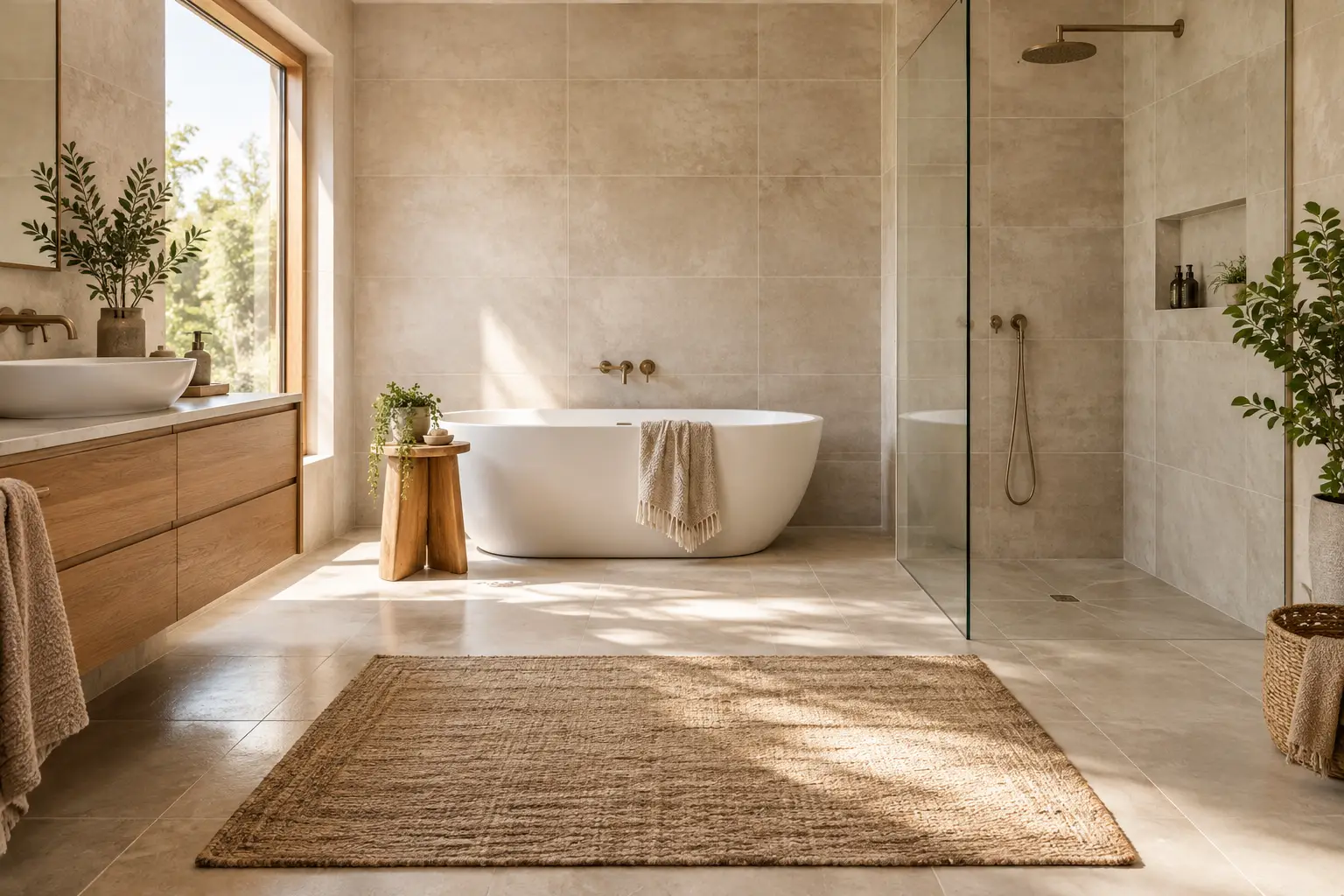
Tile has a useful clarity in Australian homes. It is cool underfoot through long summers, practical near entries and easy to live with in kitchens, bathrooms and open-plan areas. But a large expanse of tile can also make a room feel acoustically sharp, visually sparse and a little chilly once the light changes. To make tiled rooms feel warmer, focus on layers that soften the hard surface without fighting its clean, architectural quality.
The most convincing rooms do not try to hide tile. They balance it. A rug, warmer light, timber, fabric and better furniture placement can give a tiled room the sense of ease it may be missing.
1. Start with a rug that gives the room a centre
A rug is often the most effective first layer because it changes both the visual weight and the experience of the floor. In a tiled living room, it grounds the seating area so the sofa, chairs and coffee table read as one composed arrangement rather than separate pieces placed around the perimeter.
Scale matters more than pattern. In many living rooms, choose a rug large enough for the front legs of the sofa and armchairs to sit on it. This creates a deliberate connection between furniture and floor. A small rug floating beneath only the coffee table can make the tile around it feel more dominant, especially in an open-plan new build.
For a standard three-seat sofa, a 200 x 300 cm rug is often a useful starting point. Larger rooms may suit 250 x 350 cm or 300 x 400 cm, provided there is still a clear border of visible tile around the rug. The right proportion gives a room warmth without making it feel crowded.
2. Choose texture before a busy pattern
Tile already has a strong surface presence. Whether it is pale porcelain, grey stone-look tile or a darker charcoal finish, it tends to create a consistent grid across the room. A highly patterned rug can compete with that order. Texture is usually the quieter, more adaptable answer.
Look for a rug with a tactile pile, a subtle raised detail, a tonal border or soft, abstract movement. Wool brings a gentle textural quality that can feel particularly considered against smooth tile, while a low-profile construction may suit areas where doors need to clear the floor easily.
Colour also has a role. Ivory, oat, sand, warm taupe and muted clay can soften cool grey tiles without appearing overly styled. With terracotta or warm beige tile, a stone, brown or softened charcoal rug can introduce depth and keep the room grounded. Rather than matching the tile exactly, choose a tone that sits comfortably beside it.
3. Use furniture placement to interrupt the hard grid
When furniture is pushed against every wall, tiled rooms can feel larger but less settled. Pulling the seating arrangement inward by even 10 to 20 cm creates a clearer zone and gives the room a more relaxed rhythm.
This is especially useful in combined living and dining spaces. Place the living room rug first, then use the furniture around it to define its boundary. The tile can remain visible as a calm, continuous backdrop, while the rug signals where conversation and everyday downtime happen.
In a dining space, a rug can work well if it is generously sized. Allow at least 60 cm beyond the table edge on all sides, so dining chairs remain on the rug when pulled back. A 160 x 230 cm rug may work beneath a compact four-seat table, while a six- to eight-seat setting often needs 200 x 300 cm or larger. If regular spills or chair movement make a dining rug impractical for your household, bring warmth in through upholstered dining chairs, timber and softer lighting instead.
4. Add warmer light at more than one height
Cool overhead downlights can exaggerate the reflective quality of tile, particularly at night. The room may be well lit yet still feel stark. Layered lighting gives tile a softer appearance by creating pools of light rather than one even wash across the floor.
Use a floor lamp beside the sofa, a table lamp on a console or sideboard, and a pendant above the dining table where possible. Choose globes with a warm colour temperature, often around 2700K, for living areas. The goal is not dimness. It is a gentler transition between bright task lighting and the quieter atmosphere wanted after sunset.
Light also changes how colour reads. A warm-neutral rug that looks pale and crisp in morning sun can appear more enveloping in the evening under a lamp. Before committing to a large piece, consider the room at the time you use it most.
5. Bring in timber and fabric with restraint
A tiled room does not need many decorative objects to feel warmer. It needs contrast in materiality. Timber coffee tables, dining chairs, shelving or a simple oak-toned sideboard interrupt the cool, uniform surface of tile with grain and natural variation.
Then add fabric where people pause: linen curtains, upholstered seating, a woven throw or cushions with a nubby finish. These layers soften sound and make the room feel more liveable, but they are most effective when the palette is restrained. Repeating three or four related tones - perhaps sand, tobacco, ivory and a muted olive - usually feels calmer than adding a new colour in every corner.
In coastal homes with intense daylight, sheer curtains can take the edge off reflected glare without blocking the openness that makes the space appealing. In older renovated homes, fuller curtains can bring a welcome sense of weight to a room with original tile or a large glazed door.
6. Give bare tile a visual counterpoint
The issue is not always temperature. Sometimes tiled rooms feel cold because every major surface is smooth and pale. If the floor, walls, cabinetry and ceiling all have a similar finish, the eye has nowhere to rest.
Introduce one or two surfaces with more depth. A sculptural ceramic lamp base, framed artwork with warm undertones, a timber occasional chair or a textured rug can be enough. The aim is a balanced composition, not a collection of accessories.
In kitchens, where a large rug may not suit the workflow, a runner can soften the area in front of an island or along a longer bench. Keep enough clearance from appliance doors and choose a scale that follows the length of the joinery rather than sitting awkwardly in the middle of the floor.
7. Treat bedrooms and bathrooms differently
Bedrooms benefit from warmth at the first and last step of the day. For a queen bed, a 200 x 300 cm rug placed horizontally beneath the lower two-thirds of the bed usually provides a generous landing on both sides. Alternatively, two runners can work in a narrower room where a large rug would cover too much tile.
Bathrooms call for a more minimal approach. A well-proportioned bath mat, timber stool or bench, and warm wall lighting can make a tiled bathroom feel less clinical. Avoid overfilling a compact bathroom with soft furnishings. The contrast between tile and a few carefully chosen tactile elements is often more effective.
8. Work with the tile rather than against it
Not all tile needs the same response. Cool grey tile generally benefits from warmer, earthier layers. Cream or travertine-look tile may need deeper accents so the room does not become washed out. Gloss tiles reflect more light and often respond well to matte textiles and timber, while matte tiles can carry a little more sheen in a ceramic glaze or metal lamp detail.
If you are renting, start with reversible changes: a correctly sized rug, lamps, curtains and furniture placement. If you are renovating, consider the tile alongside adjoining finishes from the outset. The floor does not need to match the timber or upholstery, but their undertones should feel related. That is what gives a home continuity from room to room.
A tiled room feels warmer when it has a clear place to gather, softer materials within reach and enough tonal variation to feel lived in. Begin with the floor layer that suits your daily routine, then let the rest of the room take its cue from there.