
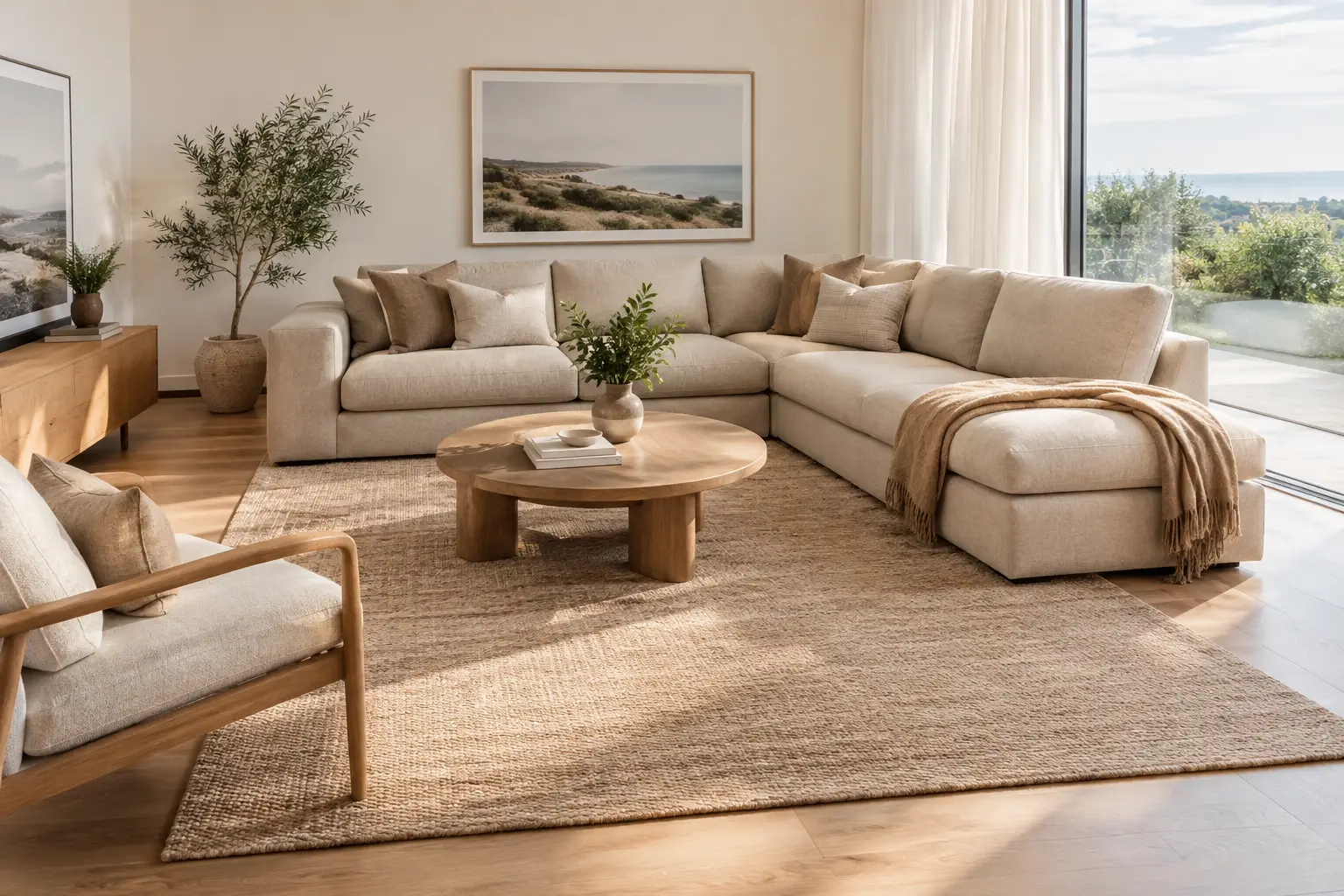
A sectional sofa can make a living room feel generous and relaxed, but its broad footprint can also make a rug look unexpectedly small. To arrange a rug with a sectional sofa well, treat the rug as the grounding layer for the entire seating zone, not as a small object placed in front of it. The right placement gives the room clearer structure, softens timber or tiled floors and makes the sofa feel intentionally placed rather than parked against a wall.
The simplest rule is this: choose a rug large enough to sit beneath the sectional’s front legs at minimum, with enough room beyond the sofa to create a balanced frame. From there, the best decision depends on the room’s proportions, the direction of the chaise and how the space is used each day.
Start with the sectional, not the rug
A sectional is rarely symmetrical. Its return, chaise or corner module creates visual weight on one side, which means a centred rug can sometimes look wrong even when its measurements are technically correct. Begin by marking out the sofa’s full footprint, including the chaise, then decide where the conversation area should begin and end.
In most living rooms, the rug should extend beyond the sectional’s outer arms where space allows. Aim for at least 15 to 30 cm past each exposed side. This gives the arrangement a composed, generous feel and stops the rug from appearing to shrink beneath the sofa.
The front edge of the rug should also reach under the sofa rather than stopping at its toes. A rug that sits 10 to 30 cm beneath the front legs visually connects the sectional to the coffee table and any occasional chairs opposite. In a larger room, placing more of the sectional on the rug can feel especially grounded.
There is one useful exception. In a compact apartment living area, a smaller rug may need to sit just in front of the sectional to preserve clear walkways. If this is the only workable option, choose a rug wide enough to align with, or extend slightly beyond, the sofa’s main straight section. Avoid a narrow rug that only spans the coffee table.
Rug sizes that work with a sectional sofa
The right size is less about a fixed formula than a relationship between furniture and floor area. Still, a few common dimensions offer a reliable starting point for Australian homes.
For a compact L-shaped sofa in a smaller lounge or apartment, a 160 x 230 cm rug can work if the sectional is modestly scaled and the rug reaches beneath the front legs. It is often better suited to a contained seating nook than a wide, open room.
A 200 x 300 cm rug is a flexible choice for many standard living rooms. It generally accommodates the front legs of an L-shaped sectional, a coffee table and a little breathing room around the arrangement. For sofas around 250 to 300 cm along their longest side, this size often creates a balanced visual field without covering too much floor.
For a generous corner sofa, open-plan family room or wide living zone, consider 250 x 350 cm or larger. A larger rug can hold the sofa, coffee table and an occasional chair within one defined area. This matters in new builds and renovated homes where living, dining and kitchen spaces share one broad floor plane.
Before deciding, use painter’s tape or sheets of newspaper to mark the proposed dimensions on the floor. Walk around the outline, open cabinet doors and notice where pathways naturally fall. This modest step is often more revealing than looking at a rug size on a screen.
Let the chaise sit within the composition
The chaise is the part of a sectional most likely to throw off the arrangement. Rather than positioning the rug only under the sofa’s main straight run, allow it to extend beneath the chaise as well. The rug does not need to mirror every edge of the sectional, but it should acknowledge its full shape.
If the chaise projects deeply into the room, a rectangular rug placed parallel with the longest wall will usually feel calmer than a square rug. The rectangle gives the sectional a stable base and creates a clear line for the coffee table. In a very square room, however, a square rug can work beautifully if it is large enough to contain the chaise without looking cramped.
Orient the rug with the room, not only the sofa. If the sectional faces a fireplace, television wall or garden view, the rug should reinforce that direction. In an indoor-outdoor living room, this often means running the long side of the rug parallel to the doors, creating a quiet connection between the seating area and the light beyond.
Keep circulation clear around the rug
Good placement is as much about movement as appearance. Leave roughly 60 to 90 cm for primary walkways around the outside of the rug where the room allows. A passage from the kitchen to the living area, or from a hallway to sliding doors, should not require people to step awkwardly around a rug corner.
In tighter rooms, prioritise a clear route over perfect symmetry. You may need to set the rug slightly closer to the sectional on one side to maintain access on the other. That is not a compromise if the result feels more liveable. Rooms are used from the doorway inward, not viewed only from one ideal angle.
Coffee table placement also affects whether the rug feels settled. Leave around 35 to 45 cm between the sectional and coffee table, adjusting for a deep chaise or a low, sculptural table. The table should sit fully on the rug, with enough surface around it for feet, books and everyday ease.
Use the rug to define an open-plan zone
In an open-plan home, the sectional often acts as a soft divider between living and dining areas. A rug makes that division more legible without closing the room off. Place it so it contains the sectional and coffee table, then let the sofa’s back create a gentle boundary behind it.
Here, scale matters more than ever. A too-small rug leaves furniture floating across a large expanse of floor and can make an otherwise well-furnished room feel fragmented. A larger rug gives the living zone visual weight, particularly against pale oak boards, concrete-look tiles or continuous stone flooring.
It is fine if the living rug does not align exactly with the dining table or kitchen island. Forcing every object onto one strict axis can make an open room feel formal. Instead, look for a balanced relationship between the zones: enough separation to make each area readable, with a tonal connection that keeps the whole space calm.
Choose colour and texture for the sofa’s visual weight
Sectionals tend to be upholstered in substantial, quiet fabrics such as cream bouclé, oatmeal linen-look weaves, warm grey or deep charcoal. The rug can either continue that restraint or offer a measured contrast.
With a pale sofa, a rug in oat, sand, stone or muted clay adds depth without making the room feel busy. A subtle border, soft grid or abstract movement can give a large rug definition while keeping the sectional as the dominant form. Where the sofa is dark, a warmer neutral rug can soften its visual weight and bring more light to the floor plane.
Texture is particularly useful when both sofa and walls are neutral. A tonal wool rug with a sculptural surface, low-and-high pile effect or restrained linear detail can add materiality without relying on strong pattern. In Australian homes with abundant daylight, this quieter approach often reads more considered than high contrast decoration.
Think, too, about everyday use. A living room shared with children, pets or frequent visitors benefits from a colour and surface that will not make every mark feel visually amplified. Mid-tones, gentle variation and texture can feel more forgiving than a flat, very pale surface. The aim is not to disguise life, but to choose a rug that remains easy to live with.
Common sectional rug mistakes
The most common mistake is choosing a rug that is proportioned for a two-seat sofa rather than a sectional. When the rug only holds the coffee table, the sofa’s long arms and chaise overwhelm it. Moving up one size is often the decision that makes the whole room feel resolved.
Another is centring the rug in the room while ignoring the sectional’s shape. A rug should be centred on the seating arrangement or the room’s primary axis, depending on which is stronger. If the chaise creates an asymmetrical composition, slight adjustment is usually more convincing than rigid geometry.
Finally, do not assume every living room needs all furniture legs on the rug. That approach can work in a large room, but it requires a substantial rug and enough floor area around it. In many homes, front legs on the rug is the more practical and balanced solution.
A well-placed rug gives a sectional sofa somewhere to belong. Start with the sofa’s full footprint, allow for daily movement, then choose the largest proportion that suits the room and budget. The result should feel quiet and deliberate: a grounded living area with enough warmth underfoot to invite people to stay a little longer.