
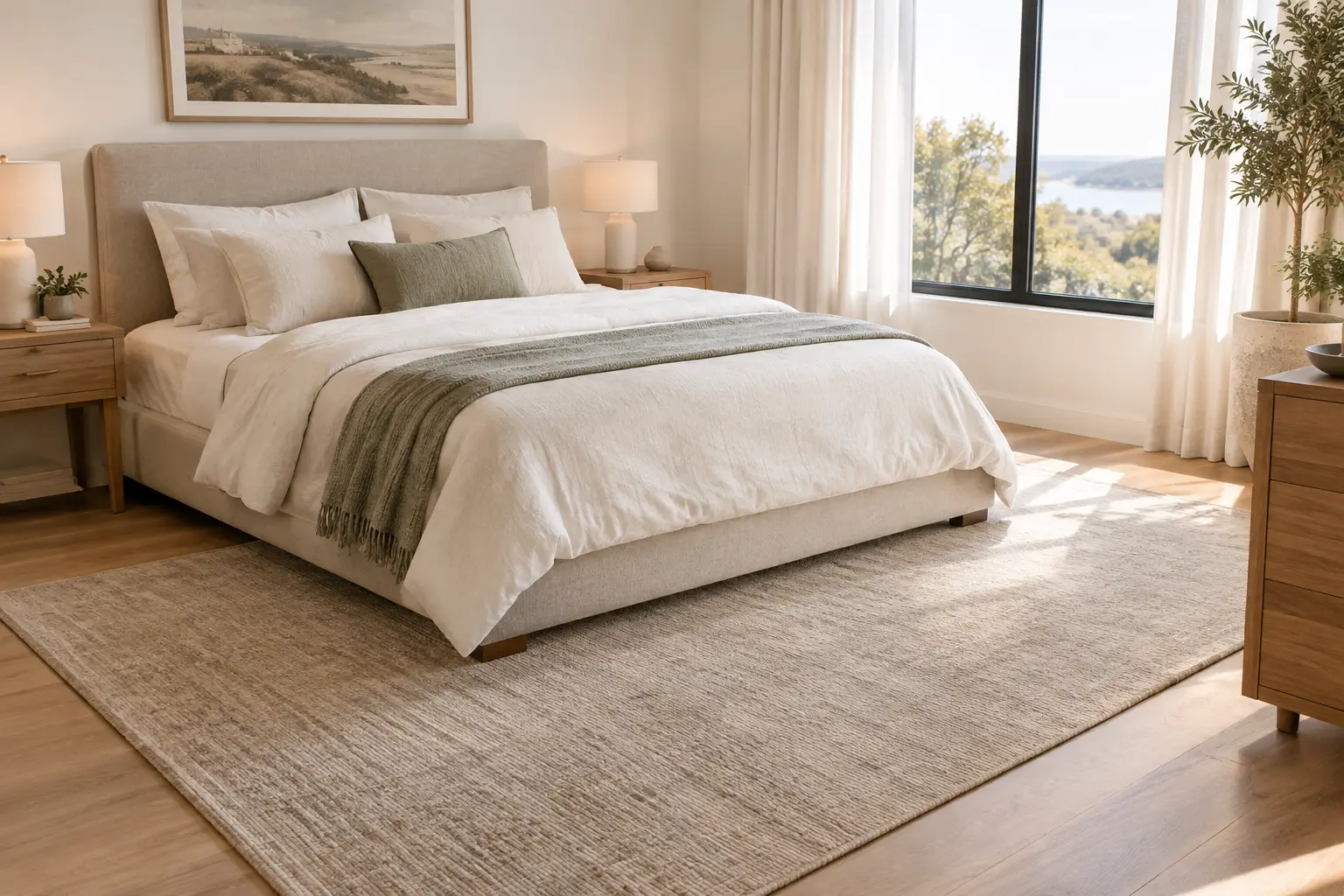
A considered bedroom rug layout begins with the bed, not the empty floor around it. The rug should give the room a grounded centre, soften the first step of the morning and create enough visual weight to make the bed feel intentionally placed. When it is too small, it can read as an isolated mat. When it is well proportioned, it brings the bed, bedside tables and surrounding floor into a quieter, more composed arrangement.
The right choice is rarely about filling every centimetre. It is about deciding where you want softness underfoot, how much floor you want to leave visible and whether the room needs a single anchoring layer or a more flexible arrangement.
Start with the bed and its clearances
Measure the bed first, then measure the room. A rug needs to extend beyond the sides of the bed far enough to be felt when you get up - usually at least 45 to 60 cm on each side. In a generous main bedroom, 60 to 90 cm feels more balanced, particularly with a king bed and wide bedside tables.
Leave a border of visible flooring around the outer edges of the rug where possible. Around 20 to 40 cm is often enough in a standard bedroom, though this depends on the room’s proportions and the position of doors, built-in robes and heating vents. A rug pressed tightly against every wall can make the floor plane feel smaller rather than more generous.
Think about the path through the room as well. In Australian homes with timber, tile or polished concrete floors, the rug can take the chill out of a winter morning. But it should not interrupt a wardrobe door, catch beneath a swinging bedroom door or create an awkward edge in the route to an ensuite.
The most useful bedroom rug layout options
Full placement beneath the bed
For a calm, hotel-like composition, place a large rug horizontally beneath the lower two-thirds of the bed. It should begin just in front of the bedside tables, allowing the bed, foot bench and surrounding floor to sit within one visual field.
This layout works particularly well in larger rooms where the bed is centred on a wall. For a queen bed, a 240 x 330 cm rug is often a strong starting point. For a king bed, 300 x 400 cm or larger may be more proportionate, depending on the room. These are guides rather than rules: a compact room may need a smaller footprint, while an expansive room can carry more rug without feeling heavy.
The advantage is cohesion. The rug gathers the bed and its furniture into a defined zone, while its tonal colour and textural surface can soften a room with hard finishes or crisp architectural lines. The trade-off is that more of the rug sits beneath furniture, so this approach generally asks for a larger budget and careful measuring.
Two-thirds under the bed
Placing a rug beneath the lower two-thirds of the bed is the most adaptable option for many bedrooms. The top edge sits below the bedside tables, while the rug extends beyond both sides and the foot of the bed. You receive the comfort of a broad landing zone without needing to cover the entire bed footprint.
This arrangement suits queen and king beds in townhouses, apartments and renovated homes where the room is comfortable but not oversized. It also keeps the bedside zone visually lighter, which can be helpful when tables, lamps and joinery already create a lot of detail.
Aim for the rug to project beyond the foot of the bed by at least 45 cm. If there is a bench at the foot, allow enough length for it to sit fully on the rug or clearly off it. Half-on, half-off furniture tends to look accidental.
Runners on either side of the bed
In a narrow bedroom, or one where a large rug would interfere with doors or built-in robes, two runners can be the better decision. Position one on each side of the bed, beginning near the bedside tables and finishing before the foot of the bed. They provide softness where it matters most while allowing more of the floor and the bed frame to remain visible.
Choose runners that feel deliberate rather than skimpy. A width of around 70 to 90 cm usually gives enough presence, while 180 to 300 cm in length will suit many queen and king configurations. The proportions should relate to the length of the bed, not merely fill a spare strip of floor.
This is also a useful layout in bedrooms with a feature bed base or a rug-worthy floor finish. It keeps the room open and liveable, though it does not create the same single, grounded field as a larger rug.
A rug at the foot of the bed
A rug placed across the foot of the bed can work in a smaller room, a guest room or a bedroom where only one side of the bed is accessible. It is less about anchoring the entire bed and more about adding a soft, sculptural layer at the point where the room opens up.
Allow the rug to extend beyond the bed on both sides. A 160 x 230 cm or 200 x 300 cm rug can work well here, depending on the width of the bed and available floor. If you use a bench, place both the bench and rug with purpose: either the bench sits fully on the rug, or the rug begins in front of it.
Rug size by bed size
Bed dimensions offer a useful reference, but bedside tables and room width matter just as much. A queen bed is approximately 153 cm wide, while a king is approximately 183 cm wide. Once bedside tables are added, the visual width can increase substantially.
For a queen bed, a 200 x 300 cm rug may suit a compact room or a two-thirds placement, while 240 x 330 cm gives more generous side coverage. For a king bed, 240 x 330 cm can work in a restrained layout, but 300 x 400 cm generally gives the bed enough surrounding space to feel balanced.
A double bed can often sit comfortably with a 160 x 230 cm or 200 x 300 cm rug, depending on whether the rug is positioned beneath the lower portion or set at the foot. In children’s rooms, a smaller rug beside the bed may be more practical than one hidden beneath it, especially where floor space is also used for play.
These dimensions are starting points, not a substitute for taping out the rug size on the floor. Painter’s tape is one of the simplest ways to see whether a proposed layout clears the door swing, aligns with a window or reaches far enough beyond the bed.
Consider visual weight, not only measurements
A bedroom rug has a larger role than its dimensions suggest. A deep brown, muted charcoal or densely patterned surface carries more visual weight than an ivory or oat rug with broad, quiet curves. In a room with dark timber furniture, a lighter tonal rug can keep the composition from feeling overly grounded. In a pale coastal bedroom with linen bedding and washed timber, a sand, stone or clay tone can create definition without introducing contrast that feels too sharp.
Texture matters too. A textural wool rug can add warmth and depth to a restrained palette, particularly in bedrooms with smooth painted walls, timber floors and simple upholstery. If the room already includes patterned bedding, detailed curtains or strong artwork, a subtle grid, soft border or low-contrast abstract design often gives the eye somewhere to rest.
Make the layout work for daily life
The most composed bedroom still needs to function on a weekday morning. If you make the bed with children climbing across it, have a dog that claims the sunny patch near the window or rely on under-bed storage, placement needs to respond to that reality. A full rug beneath a heavy bed may be impractical if you regularly access drawers underneath. Runners may make more sense if the floor needs frequent cleaning or if only one side of the bed is used.
Use a suitable rug underlay where needed to help the rug sit flat and reduce movement, especially on smooth timber or tiled flooring. It also helps a larger rug hold its intended shape, so the edges remain straight in relation to the bed and walls.
There is no need for every bedroom to follow the same formula. A generous main bedroom may benefit from a broad rug that gathers the furniture together, while a compact guest room can feel resolved with a single runner and a well-placed chair. The clearest decision is usually the one that gives your feet a soft landing, leaves enough room to move easily and makes the bed feel properly at home in the room.