
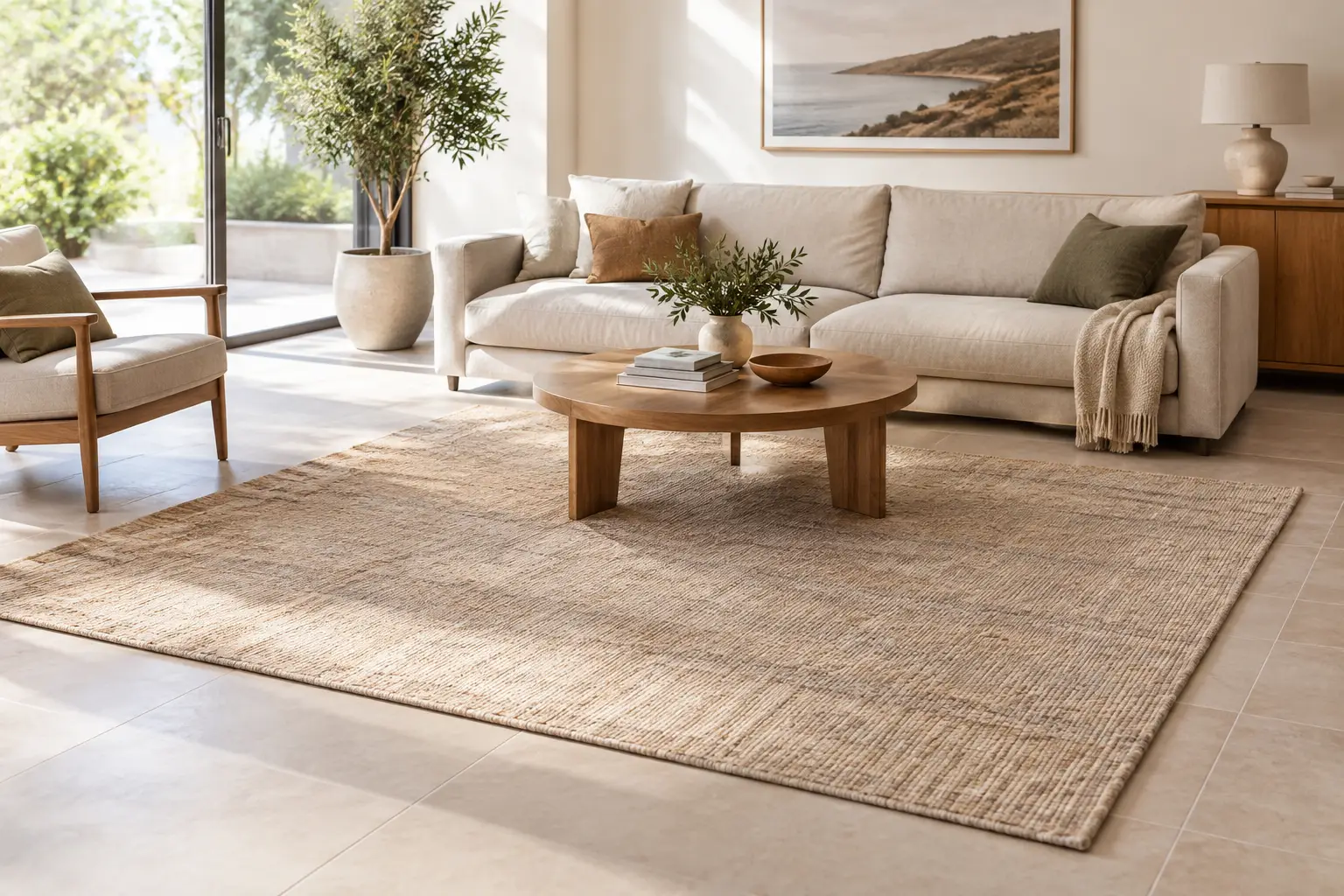
Tile has a lot to recommend it in an Australian home: it is cool through a long summer, easy to live with and visually clean. Yet a fully tiled room can feel acoustically sharp, a little exposed and colder underfoot once the weather turns. The best rugs for tiled floors soften those qualities without fighting them. They add materiality, define how a room is used and bring a more settled feeling to hard, reflective surfaces.
The right choice is rarely about finding the thickest rug or the busiest pattern. It is about proportion, texture and a foundation that stays composed alongside the tile. A rug should feel like an architectural layer within the room - grounding the seating area, drawing furniture into relation and giving an open-plan layout clearer edges.
Start with the room, not the tile colour
Many tiled floors sit in a neutral range: soft grey, warm beige, ivory, stone or charcoal. It can be tempting to match a rug precisely to the floor, but this often leaves the room flat. Instead, look for a considered shift in tone or texture.
On cool grey tiles, oat, sand, mushroom and muted clay can introduce warmth without making the scheme feel overly contrasting. If the tiles have a creamy or travertine-like cast, a rug in taupe, brown, charcoal or a deeper natural fibre tone gives the room visual weight. A tonal rug can still be quiet, provided its surface has enough variation to separate it from the floor.
Pay attention to the undertone rather than the colour name. A beige tile may lean pink, yellow or grey; an ivory rug may have a soft cream base or a cooler chalky one. Bring samples into the room where possible and look at them in morning, afternoon and artificial light. This matters particularly in coastal homes and new builds, where broad windows can make pale tiled floors appear much brighter than they do online.
The best rugs for tiled floors have texture and visual weight
Tiled floors tend to be smooth, hard and reflective. A rug with a tactile surface offers useful contrast, whether that is a low, textural wool pile, a sculptural loop or a restrained cut-and-loop pattern. The aim is not to make every surface soft. It is to create a balanced mix of finishes: tile, timber, upholstery, linen, ceramics and a rug with enough presence to hold them together.
Wool is a natural fit for living spaces with tile because it brings warmth and a nuanced, light-catching surface. A wool rug in a warm-neutral palette can make a large tiled area feel less stark while remaining visually calm. It also suits interiors built around timber furniture, linen curtains and soft upholstery, where a synthetic-looking sheen can feel out of place.
Pile height is a practical consideration. A medium or lower pile often works well beneath a coffee table and around everyday seating because it gives the area definition without looking overly plush against a crisp floor. A more dimensional surface can be particularly effective in a quieter room, such as a formal sitting area or bedroom, where the rug is allowed to read as a sculptural object.
Highly detailed patterns are not essential. Tiles already create a grid through grout lines, especially in larger open-plan rooms. Broad, quiet curves, a subtle border, softened geometry or abstract movement will usually sit more easily than a small, high-contrast repeat. If your tile has strong veining, mottling or a pronounced pattern, choose a rug with a more restrained surface so the two do not compete.
Choose size before you choose a design
A rug that is too small is one of the quickest ways to make a tiled room feel fragmented. Small islands of softness surrounded by a large expanse of tile can make furniture look as though it is floating apart. A more generous rug gives the eye a clear boundary and makes the room feel intentional.
In the living room
For most living rooms, allow the rug to sit under at least the front legs of the sofa and occasional chairs. This creates a connected seating zone rather than placing a small rectangle in the middle beneath the coffee table. In a compact apartment living room, a 160 x 230 cm or 200 x 300 cm rug may be appropriate, depending on the sofa size. In a larger room, 250 x 350 cm or 300 x 400 cm can provide the proportion the furniture needs.
Leave a visible border of tile around the rug rather than running it wall to wall. Around 20 to 40 cm is often enough, although the right amount depends on the room dimensions. This border lets the tile remain part of the composition while the rug establishes a warmer centre.
Under a dining table
In dining areas, the rug needs to extend beyond the table far enough for chairs to stay on it when pulled back. As a useful starting point, allow at least 60 cm on each side. This is less about rigid rules than everyday ease: if chair legs catch on the rug edge, the arrangement will feel awkward in use.
A low-profile or lower-pile rug is usually the more practical choice here. It keeps the table stable and lets chairs move with less resistance. Consider the dining setting as a whole, including the width of your chairs and whether a sideboard or sliding door narrows the zone.
Beside and beneath the bed
Tile can feel especially cool in bedrooms during winter mornings. A rug beneath the lower two-thirds of the bed, extending beyond each side, creates softness where feet first meet the floor. Alternatively, two runners can work in tight rooms where a larger rug would disappear beneath the bed frame.
For a queen bed, a 200 x 300 cm rug is often a useful starting point. King beds generally need more width, particularly where bedside tables sit outside the rug. Check that the rug extends far enough beyond the sides of the bed to be felt, not merely seen.
Do not overlook the rug pad
A rug pad is particularly worth considering over tile. The floor is hard and smooth, so a suitable pad helps the rug sit more securely and prevents it from feeling thin or shifting as people move through the room. It can also add a little cushioning underfoot and reduce the hard contact between rug and tile.
Choose a pad designed for use on tiled surfaces, and make it slightly smaller than the rug so it remains hidden. Before committing, check the flooring manufacturer’s care guidance and test a small area if you are concerned about finishes or grout. Keep the floor beneath clean and dry, as grit can affect how both the rug and pad sit over time.
Consider how the room is actually used
The most considered choice accounts for daily life, not only a styled photograph. A pale, textural wool rug can bring welcome softness to a quiet lounge or main bedroom, but an entry beside a garden door may call for a darker tone or a more forgiving surface. In an indoor-outdoor living area, sand, taupe and muted charcoal often carry the visual connection to paving and landscaping more easily than a very light ivory.
For homes with children, pets or frequent entertaining, a mid-tone rug with tonal movement can be more liveable than a flat pale field. This does not mean a dark rug is always the answer. Deep charcoal can visually shrink a small room or feel heavy against pale tile. Often the middle ground - oatmeal with brown flecks, warm grey with a subtle grid, or clay balanced with cream - has more everyday ease.
Also consider where sunlight falls. Strong Australian light can make a rug appear lighter and more contrasty than expected, while a south-facing room may benefit from the warmth of a deeper neutral. Rotate the rug periodically if one side receives considerably more light than the other, and follow the care guidance supplied for its particular material and construction.
Let the rug create a calmer relationship between surfaces
Tiled floors do not need to be hidden. Their clean planes can be an excellent backdrop for a rug with depth, a sofa with a softer profile and a timber table with visible grain. The most successful arrangement lets each material do its job: tile keeps the room crisp, while the rug introduces warmth, absorption and a sense of place.
Before settling on a design, mark the proposed rug size on the floor with painter’s tape. Walk around it, pull out dining chairs and view it from the doorway. That small exercise often clarifies whether the room needs a larger footprint, a quieter colour or a more textural surface - and leads to a choice that will continue to feel grounded as the rest of the home evolves.