
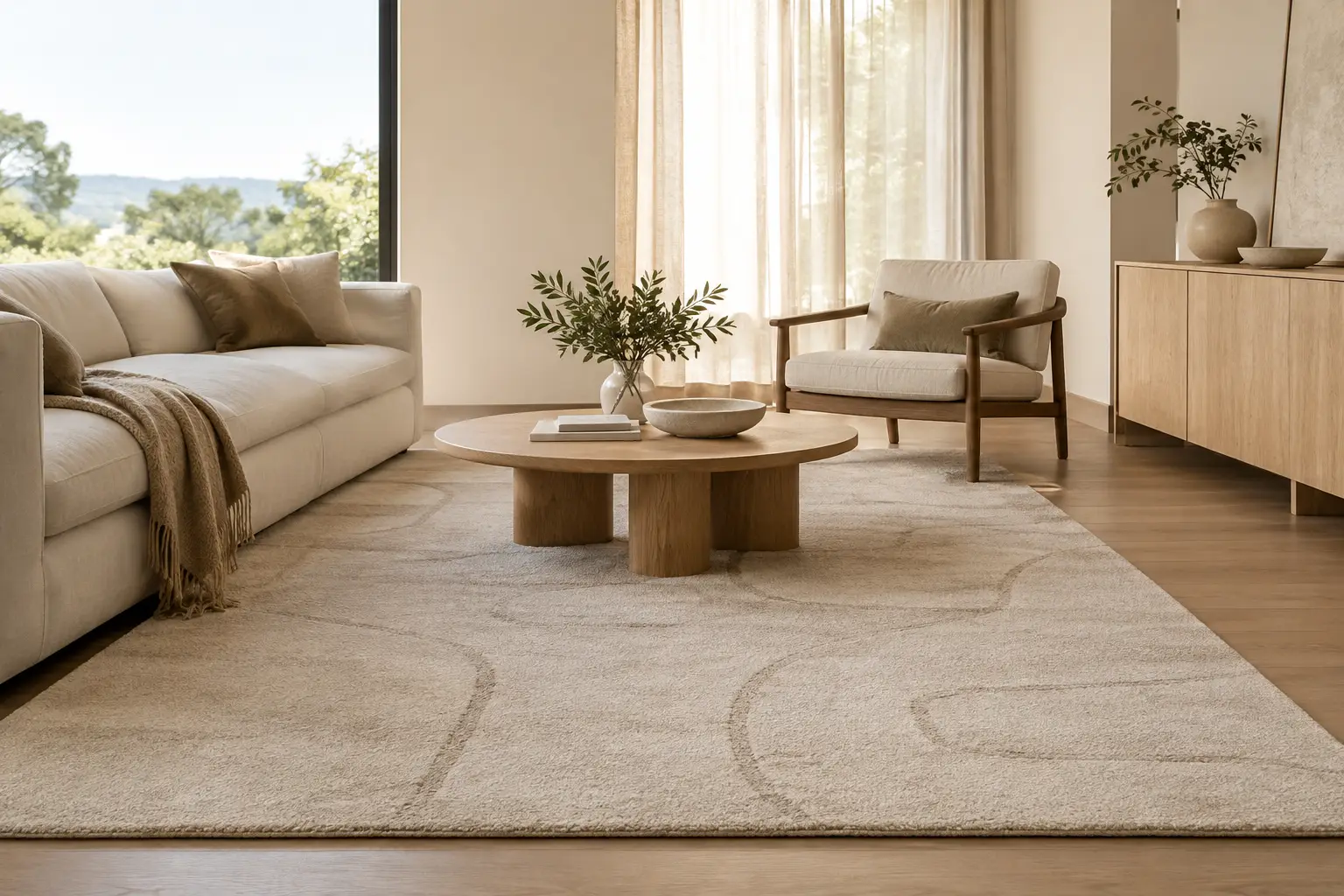
A rug can make a carefully furnished room feel either settled or slightly adrift. In a living area with timber floors, soft upholstery and plenty of natural light, hand tufted wool rugs introduce the material weight that holds those elements together. They soften the space underfoot, absorb some of the visual hardness of floor finishes and give furniture a clearer sense of placement.
For many homes, their appeal lies in the balance of texture and restraint. Wool brings warmth and tonal depth, while hand-tufted construction makes room for sculptural pile, quiet curves, raised lines and abstract forms that read as part of the architecture rather than decoration added at the end.
What hand tufted wool rugs are
Hand-tufted construction describes the way pile yarn is inserted through a foundation cloth to create the rug’s surface. A backing is then applied to help hold the pile in place. This approach can accommodate varying pile heights, carved details and considered shifts in texture, which is why it suits contemporary designs with soft geometry, folds, grids or broad, quiet curves.
It is worth separating construction from appearance. A hand tufted rug is not the same as a hand-knotted rug, and the term alone does not tell you everything about finish, pile density or how a particular rug will suit your household. Look beyond the label to the material, the height and feel of the pile, the design’s visual weight and the care guidance supplied for that specific piece.
Texture is part of the design, not an afterthought
The most successful hand tufted wool rugs tend to have a clear textural idea. A low, even field with a raised border can frame a seating area without making it feel formal. A cut-and-loop surface can introduce subtle movement in a room built around linen, oak and stone. A higher pile may feel more generous in a bedroom, where bare feet and a quieter atmosphere matter most.
These details alter how a rug catches light. In a sunny coastal room, a tonal ivory or oat design can reveal gentle shadow across its surface through the day. In an inner-city apartment with less direct light, a warmer taupe, clay or soft brown can prevent the floor plane from feeling flat. The effect is understated, but it helps a room feel composed rather than overly styled.
Why wool works in a liveable home
Wool has a naturally tactile quality that synthetic fibres often try to imitate. It has visible variation, softness and a warmth that works especially well against hard floors common in Australian homes, including engineered timber, polished concrete, tile and stone. It also suits a restrained palette because its surface carries tonal shifts rather than appearing uniformly coloured.
That does not mean wool asks nothing of you. Some shedding is normal, particularly when a wool rug is new, and can be more noticeable with plusher piles or darker flooring beneath. Regular gentle vacuuming helps remove loose fibres and everyday dust. Follow the care instructions for the individual rug and avoid treating a spill with an aggressive cleaner before checking whether it is suitable for wool.
Wool is a considered choice for people who value materiality and are comfortable with a natural fibre behaving like a natural fibre. If your priority is a surface that looks entirely unchanged with minimal attention, it may not be the right fit. If you want warmth, texture and a rug that makes a room feel less hard-edged, its character is often the point.
Choosing the right scale before the right design
A well-proportioned rug does more for a room than a more decorative but undersized one. Before deciding between a curved motif or a quiet border, map out the footprint with masking tape. This is particularly useful when buying online, as it lets you see how the rug will relate to door swings, walkways and furniture legs.
In the living room
For a typical seating area, aim for the front legs of the sofa and occasional chairs to sit on the rug. This creates a visual connection between the furniture rather than leaving the rug floating in the centre like a small island. In larger rooms, placing all furniture legs on the rug can create a more generous, grounded arrangement.
As a starting point, a 200 x 300 cm rug can suit a compact apartment living zone, while 250 x 350 cm or 300 x 400 cm often gives a family room the proportion it needs. The right choice depends on the sofa length and room width, not simply the amount of empty floor. Leave enough visible flooring around the edges for the room to breathe.
In the bedroom and dining area
In a bedroom, a rug should extend beyond the sides and foot of the bed so it is felt when you get up. For a queen bed, 200 x 300 cm often works when placed horizontally beneath the lower portion of the bed. A king bed generally benefits from a larger footprint, especially if bedside tables are included in the composition.
Under a dining table, allow at least 60 cm beyond the table edge on every side where possible. Chairs should remain on the rug when pulled back. A too-small dining rug is not only visually awkward - chair legs can catch on the edge during everyday use.
In open-plan homes, separate rugs can give each zone a clear purpose without adding walls. One might anchor the lounge while another defines the dining setting. Keep them related through colour temperature or materiality, rather than choosing matching patterns. An oat-toned living rug and a deeper stone-toned dining rug can feel balanced without becoming overly coordinated.
Let colour support the room’s existing materials
A hand tufted wool rug rarely needs to be the loudest element in a room to have presence. Warm-neutral palettes are often more flexible because they respond to changing cushions, artwork and furniture over time. Ivory, sand and oat work well with pale timber, creamy walls and coastal light. Taupe, brown and muted charcoal can add definition to a room with generous daylight or pale, expansive flooring.
When choosing a tonal rug, look at the undertones already present. Beige upholstery can lean pink, yellow, grey or green. Timber may be honeyed, red-brown or weathered. A rug that shares one of these underlying notes will feel integrated, even when it is a different shade. By contrast, a cool grey rug in a room dominated by warm oak and cream can make the palette feel divided.
Pattern should be considered at the scale of the room. A sculptural, low-contrast design may bring interest to a pared-back interior without competing with veined stone or expressive artwork. In a room with patterned curtains, strong joinery grain or many small objects, a quieter rug surface can create visual calm.
Care that preserves everyday ease
Place a rug on a clean, dry floor and use an appropriate rug underlay where needed to add cushioning and help it sit evenly. Vacuum regularly using a setting suited to the pile, taking care with fringes or raised textural areas if your rug has them. Rotate the rug occasionally so that sunlight and foot traffic are not concentrated in one place.
For spills, act promptly by blotting with a clean, absorbent cloth rather than rubbing. Rubbing can push moisture further into the pile and disturb the surface. Avoid saturating the rug, and seek advice from a professional cleaner for marks that do not lift with gentle treatment or for any substantial spill.
Direct sun is worth considering in Australian homes, particularly in west-facing rooms and glass-heavy new builds. Sheers, blinds and sensible placement can reduce prolonged exposure while still allowing the room to enjoy its natural light. This is less about treating a rug as precious and more about making a practical decision for the way the room is used.
A rug with presence, without excess
Hand tufted wool rugs suit homes that need softness and structure in equal measure. They can make a compact lounge feel more intentional, give an open-plan area clearer boundaries or bring tactile relief to a room of clean-lined joinery and hard flooring. Their value is not simply in filling a bare patch of floor, but in the way proportion, colour and texture help everything around them sit more comfortably.
Start with the room’s dimensions and daily rhythms, then choose the surface that gives the space the warmth and visual calm it has been missing.