
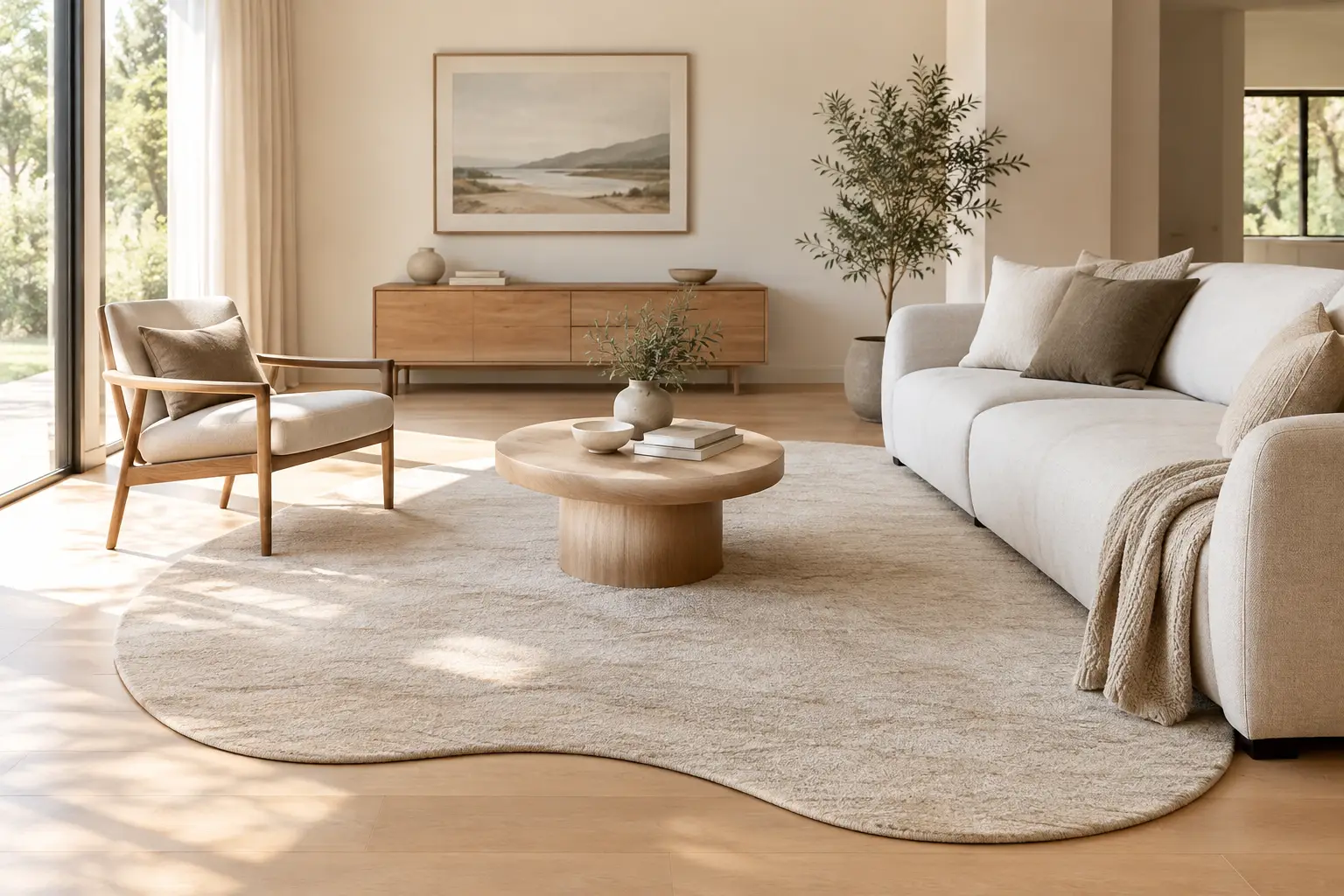
A room with a low, linear sofa, rectangular coffee table and straight-edged cabinetry can feel orderly, but occasionally a little fixed. Curved rugs introduce a gentler counterpoint. Their broad, quiet arcs soften hard finishes, interrupt an overly rigid layout and give a seating area a more relaxed sense of movement without relying on a loud pattern.
They are not right for every room, nor are they simply a decorative alternative to a rectangle. A curved form changes how a rug meets furniture, walls and walkways, so proportion and placement matter more than usual. Chosen with care, it can become an architectural layer that makes a room feel more composed and liveable.
Why curved rugs feel different
Most furnishings are based on straight lines: the edge of a sofa, joinery, a dining table, floorboards and the perimeter of the room. A rug with a rounded edge or an organic outline creates contrast against these elements. It draws the eye through the space rather than stopping it at a hard boundary.
This is particularly effective in contemporary Australian homes with timber, tile, stone or polished concrete underfoot. Those surfaces benefit from tactile softness, while a sculptural rug shape can take some of the visual severity out of an open-plan new build. In a renovated character home, it can also sit comfortably beside more traditional architectural details, provided the palette remains restrained.
The effect should be subtle. A curved rug is often most successful when its colour is tonal and its texture carries some depth. Think ivory against warm oak, oat beside cream upholstery, or a clay and brown composition grounding a charcoal sofa. The shape supplies movement, so the rest of the design does not need to compete for attention.
Where curved rugs work best
Curved forms tend to feel most natural where a room already has a reason to soften. A living room with rounded occasional chairs, a circular coffee table, an arched doorway or a generous modular sofa is an obvious fit. Yet they can be equally useful where there are no curves at all, because they break up a box-like plan.
Living rooms with a defined seating zone
In a living room, the primary job of the rug remains the same: to ground the seating area and bring separate pieces of furniture into one visual composition. A curved edge should not compromise that job. Wherever possible, place the front legs of the sofa and occasional chairs on the rug, allowing enough surface area in front of the furniture for the shape to read clearly.
For a standard three-seat sofa, a rug around 200 x 300 cm or 250 x 350 cm is often a useful starting point, depending on the room and furniture depth. With an irregular or asymmetrical curved design, assess the overall footprint rather than focusing only on its longest measurement. The rug should still extend beyond the sofa’s sides where space allows, usually by around 15 to 30 cm, to avoid looking undersized.
A rounded edge facing into the room can make a compact lounge feel less crowded, especially when it follows the curve of a coffee table or creates a generous path around it. Keep at least 30 to 45 cm between the rug and walls in a smaller room where possible. That visible border of flooring helps the zone feel intentional rather than squeezed in.
Open-plan homes that need gentle structure
Open-plan living has its advantages, but a large room can become visually loose when the kitchen, dining and lounge all share one floor. Curved rugs can define the lounge without cutting the room into hard rectangles. This is useful in homes where the seating area faces garden doors, a courtyard or a view, and the circulation route naturally runs behind the sofa.
Here, consider the direction of movement. A sweeping edge can guide the eye around a walkway and leave the main passage clear. It should not project into a busy route from kitchen to dining table, where a lifted corner or awkward pinch point will quickly become frustrating. Map the placement with newspaper, painter’s tape or a folded sheet before committing. This simple test reveals whether the rug gives the furniture enough visual weight while preserving everyday ease.
Bedrooms that feel a little too angular
A curved rug can soften a bedroom dominated by the straight lines of a bed, bedside tables and built-in robes. Rather than placing one directly under the entire bed, consider a shape that extends visibly from the lower two-thirds and sides. The key is generous exposure: aim for approximately 45 to 60 cm of rug beyond each side of the bed and at least 60 cm at the foot where room allows.
In a smaller bedroom, a curved runner or a pair of smaller rugs beside the bed may be more proportionate. This approach gives warmth underfoot on cool mornings without forcing an oversized shape between furniture and walls.
Choosing the right curved rug shape
Not all curved rugs behave in the same way. Some have a single rounded end, some use a soft scallop, and others follow an abstract, free-form outline. The most suitable option depends on whether you want to guide movement, soften an existing layout or create a focal point.
A rug with one broad rounded edge is usually the easiest starting point. It retains enough structure to sit beneath a sofa or bed, while the curved side provides relief from a grid of straight lines. A more organic silhouette has greater sculptural presence and can look striking beneath low furniture, but it needs sufficient clear floor around it. If its outline is hidden by too many legs, side tables and baskets, the considered shape is lost.
Avoid choosing a form simply because it looks distinctive in isolation. A rug should relate to the room’s proportions first. In a narrow apartment living area, for example, an expansive asymmetrical curve may restrict circulation. A restrained design with one softened edge may do more for the room.
Colour and texture: let the shape do its work
Because a curved rug already creates visual movement, a warm-neutral palette often gives it longevity. Ivory, sand, stone, taupe and muted brown work well with the materiality common in Australian interiors: pale timbers, linen, creamy painted walls, travertine-look surfaces and soft upholstery. These colours do not disappear, but they allow the form and texture to register slowly.
Darker tones can be equally grounded in a light room. A muted charcoal or deep brown rug can anchor a pale sofa and prevent the seating area from feeling as though it floats across a large expanse of floor. The trade-off is visual weight. In a compact space with limited natural light, a darker rug will feel more pronounced, so balance it with lighter upholstery or a clear border of visible flooring.
Texture matters as much as colour. A low, even surface reads cleaner and more architectural, while a more tactile finish introduces softness and variation. Consider daily use when making that choice. Dining areas and high-traffic paths often benefit from a surface that feels straightforward to maintain, while a bedroom or lower-use sitting room may allow for more textural depth. Always check the care guidance for the particular rug before deciding where it will live.
Common placement mistakes to avoid
The most common mistake is treating a curved rug like a small accent mat. When it sits entirely in front of a sofa without connecting to its front legs, the seating arrangement can appear fragmented. Scale usually solves this more effectively than extra cushions or decorative objects.
Another is forcing a curve to mirror every rounded item in the room. Repetition can become overly literal. One or two related forms are enough: a curved rug might sit with a round coffee table, while the remaining furniture stays clean-lined and restrained.
Finally, allow the rug to look intentionally placed rather than centred by default. In an open-plan room, the furniture zone may sit slightly off-centre within the wider floor area because it responds to a fireplace, kitchen island or window line. Centre the rug on the seating composition, not necessarily on the room itself.
A well-chosen curved rug does more than soften a floor. It gives a room a quieter rhythm, holds furniture in balance and makes the space feel considered without becoming overly styled. Start with the layout you need to live with each day, then choose the curve that makes that arrangement feel more settled.