
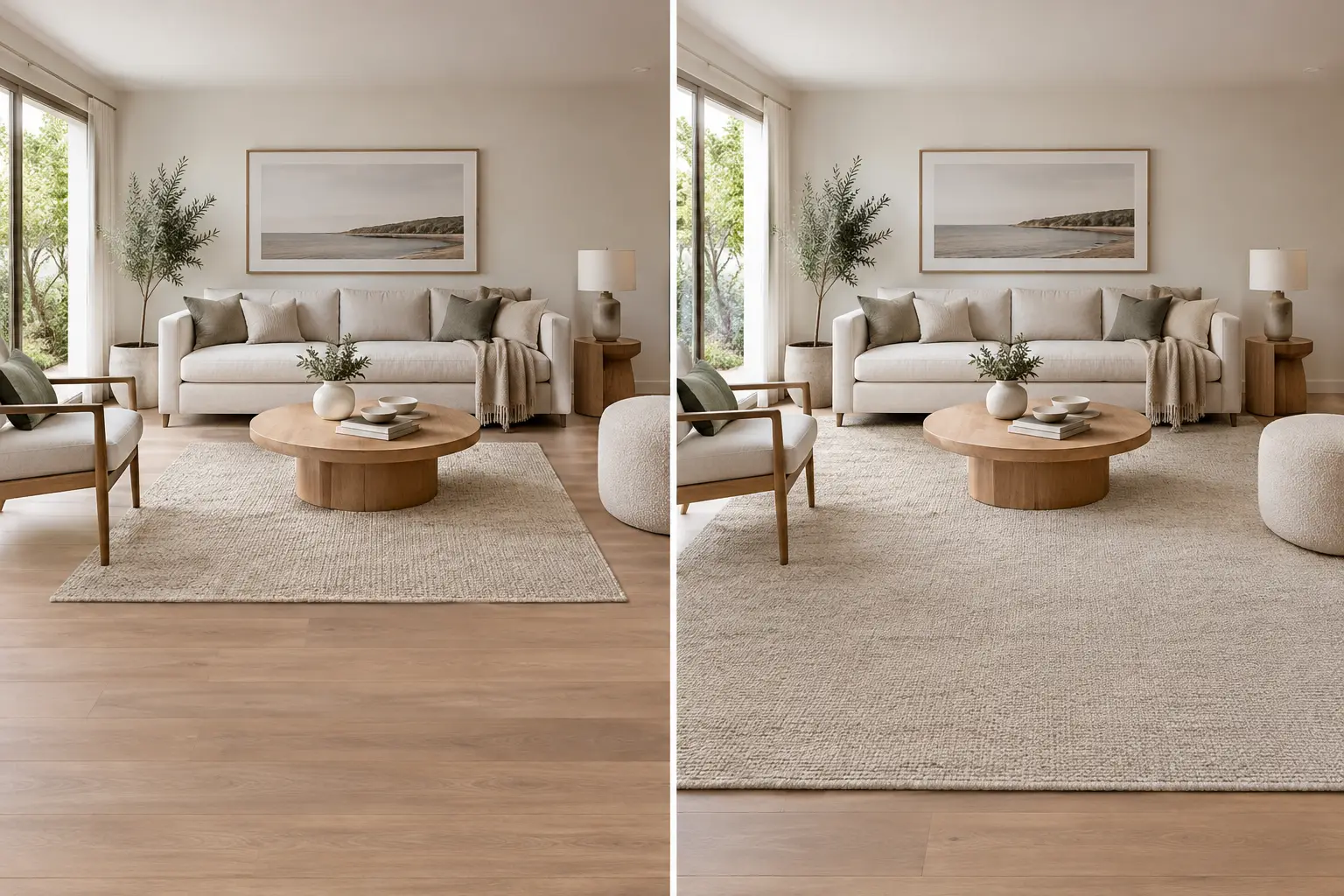
A rug that is slightly too small can make an otherwise considered room feel unsettled. Furniture appears to float, walking paths become fragmented and the room loses the quiet structure that helps it feel resolved. When deciding between large or small rugs, the answer is usually less about the room’s dimensions alone and more about what the rug needs to hold together.
In most living rooms and bedrooms, it is better to err towards a larger rug. More generous scale creates visual calm, gives furniture a shared foundation and softens the hard finishes common in Australian homes, from timber floorboards and polished concrete to tile. A smaller rug can be exactly right, but it needs a clear purpose: defining a reading corner, sitting beside a bed or adding warmth to a compact entry.
Large or small rugs: begin with the furniture
A rug is an architectural layer, not an object placed in the empty space left after furnishing. Start by looking at the furniture grouping you want it to anchor. The outer edge of the rug should relate to the sofa, chairs, bed or table, rather than simply tracing the centre of the room.
A large rug brings separate pieces into one composed arrangement. It is particularly useful in open-plan homes, where a sofa may sit away from the wall and the living zone needs to feel distinct from the dining area or kitchen. Its visual weight makes the room feel more intentional, even where the palette is restrained.
A small rug leaves more floor visible, which can feel light and practical in a compact apartment or narrow room. But it should not be treated as a default budget compromise. If it only sits beneath the coffee table, with no connection to the seating around it, it can visually shrink the whole arrangement.
The most useful question is: should this rug define a zone, or simply soften one small moment within it? Define a zone with scale. Soften a moment with a smaller piece.
Living rooms need a generous footprint
In a living room, the rug should usually sit under at least the front legs of the sofa and any occasional chairs. This creates a connection between the furniture while allowing the room to retain breathing space around the edges.
For a standard three-seat sofa, a 200 x 300 cm rug often works in a compact living room, provided the seating arrangement is not overly wide. In a more spacious room, or one with a chaise, two sofas or generous armchairs, 250 x 350 cm or 300 x 400 cm may create a more balanced result. The right size depends on the furniture footprint, not simply whether the house is large.
Ideally, allow around 15 to 30 cm of rug beyond each side of the sofa where the layout permits. This lateral extension gives the arrangement a settled, grounded quality. If the rug stops well inside the sofa’s width, the seating can feel top-heavy and disconnected.
There are exceptions. A small, sculptural rug may work beneath a single lounge chair and side table, especially in a bedroom corner or beside a window with soft morning light. Here, its purpose is not to anchor the whole room. It creates a contained pause within it.
Keep circulation in mind
Scale should never come at the expense of everyday ease. In a narrow lounge, a larger rug may need to stop short of a major walkway rather than forcing people to step awkwardly on and off its edge. Aim for a clear path of roughly 60 to 90 cm where possible.
For homes with doors that open into the room, measure the door swing before choosing a thicker rug. Placement needs to work for the way a home is actually used, not only for the floor plan.
In dining rooms, the table sets the size
Dining rugs are one of the clearest cases for choosing large. A rug should extend beyond the table far enough that dining chairs remain on it when pulled back. As a guide, add at least 60 cm to each side of the table, and more if the chairs are deep or the room allows.
For example, a 180 cm long dining table generally needs a rug at least 300 cm long. A 200 x 300 cm rug may suit a smaller four-to-six-seat table, while a 250 x 350 cm size can better support a longer table and eight chairs.
A rug that catches chair legs halfway out is frustrating in daily use and visually unsettled. A larger size offers a calmer field beneath the dining setting, particularly against timber or tiled floors where a textural surface can soften the room’s acoustics and visual hardness.
Round tables often sit naturally on round rugs, especially in a breakfast nook or apartment dining area. Still, a rectangular rug can work well when it reflects the shape of the room or aligns with nearby cabinetry. There is no requirement to match every shape. Proportion matters more.
Bedrooms benefit from softness at the edges
In a bedroom, the rug’s job is often simple: offer warmth underfoot and create a sense of enclosure around the bed. For a queen bed, a 240 x 330 cm rug is often a comfortable starting point if it sits horizontally beneath the lower two-thirds of the bed. For a king bed, 300 x 400 cm may be more appropriate in a generously sized room.
The rug should extend beyond both sides of the bed, ideally by 45 to 60 cm or more. It can also project beyond the foot of the bed, bringing visual balance to a bedframe, bench or folded throw at the end of the room.
In tighter bedrooms, two runners or smaller rugs placed on either side of the bed can be the more practical choice. This approach keeps the floor feeling open, avoids crowding built-in robes and still provides a tactile landing place each morning. It is especially useful in renovated character homes, where room proportions can be less forgiving than in newer builds.
Use smaller rugs to create clear, quieter zones
Small rugs are most effective when they are deliberately contained. Think of an entry where shoes come off, a reading chair beside a bookcase, a window seat, a study nook or the space in front of a compact console. In these settings, a 120 x 180 cm or 160 x 230 cm rug can offer texture and warmth without trying to carry the entire room.
They also work well in layered interiors. A smaller piece over a larger, neutral base can introduce a different surface or subtle geometry, though this needs restraint. Keep the colours tonal and ensure the top rug is large enough to look intentional rather than incidental.
A small rug can also be useful where you want to preserve a strong view of original boards, terrazzo or stone. It allows the floor finish to remain part of the room’s materiality while giving one area a little more softness.
Check the boundaries before deciding
Before committing to a size, mark the proposed rug dimensions on the floor with painter’s tape. This simple step reveals more than a product image ever can. Walk around it, pull out dining chairs, open doors and notice where the edges sit in relation to furniture legs.
Look for a balanced border between the rug and the walls, but do not chase symmetry at all costs. In an open-plan room, the rug may be positioned around the seating zone rather than centred within the entire space. In a room with a fireplace, bay window or built-in joinery, architectural features will naturally influence placement.
Also consider colour and texture alongside size. A large rug in a warm-neutral, tonal palette can feel quiet and expansive. A heavily contrasted pattern at the same scale will carry more visual weight. If the room already has expressive artwork, veined stone or patterned upholstery, a restrained textural surface may allow the room to feel more balanced.
The considered choice is rarely the smallest one
Choosing a larger rug can feel like a significant commitment, particularly when furnishing a first home, apartment or growing family space. Yet a rug with enough scale often allows existing furniture to feel more cohesive, reducing the need to add more decorative pieces just to make a room feel finished.
That does not mean every room needs a large rug. Small, purposeful rugs bring character to the edges of a home and make compact spaces feel considered. The key is to match the rug to the zone it is supporting, then give it enough room to do that work well. Measure the furniture, map the footprint and choose the scale that lets your home feel calm underfoot and composed from every angle.