
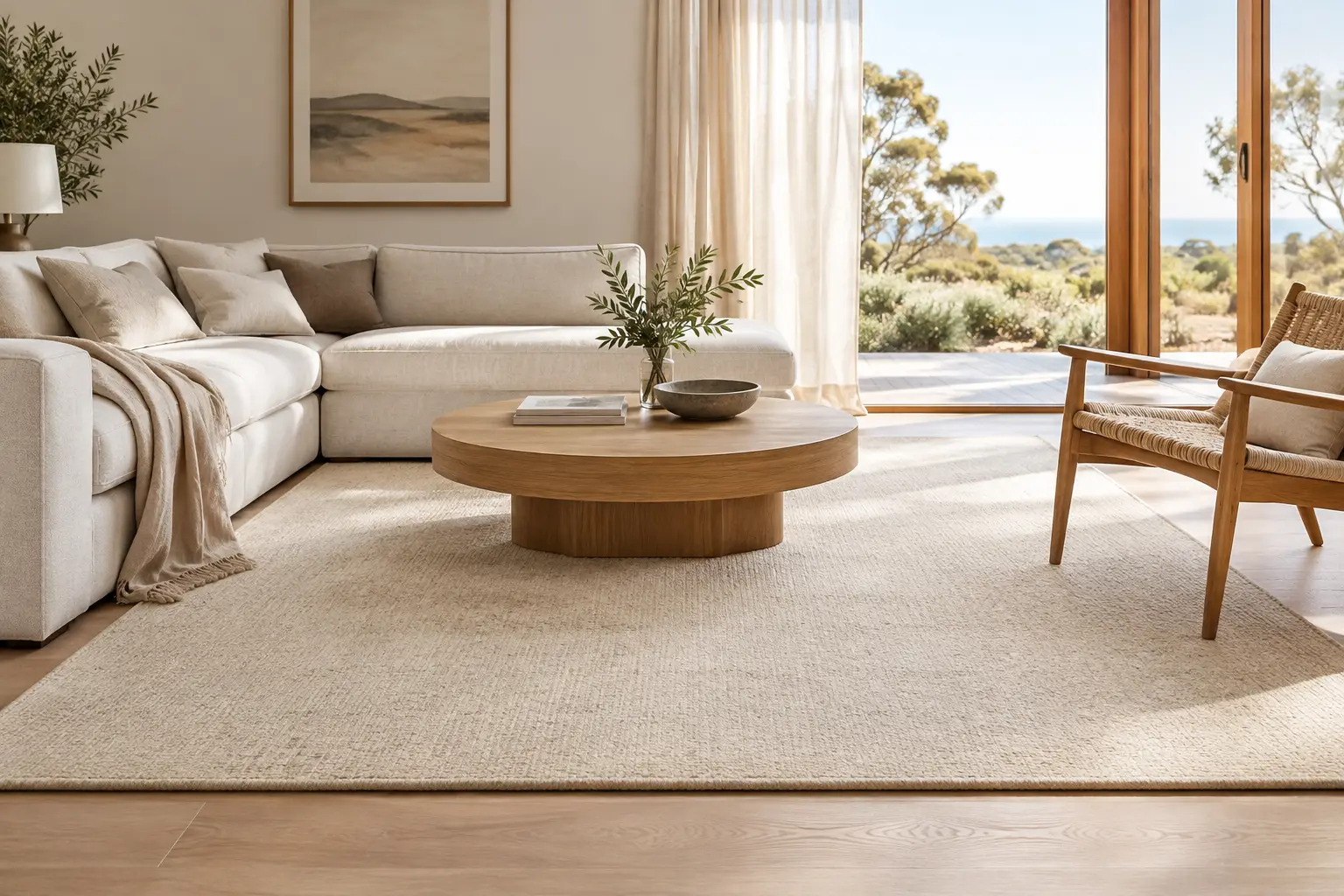
A minimalist rug should not disappear into a room. It should make the room feel more resolved. For Australians considering minimalist rugs Australia-wide, the strongest choice is rarely the plainest one - it is the rug with enough texture, tonal depth and proportion to ground the space without competing with it.
This is particularly valuable in homes with timber floors, pale tiles, warm-white walls and open-plan living areas. These finishes create a clean starting point, but they can also leave a room feeling sparse or acoustically hard. A considered rug introduces softness underfoot, gathers furniture into a clear composition and gives the eye a quiet place to rest.
What makes a rug feel minimalist?
Minimalism is not the absence of detail. It is restraint in how detail is used. A rug with broad, quiet curves, a subtle grid, a softened border or low-contrast abstract movement can feel more minimal than a flat block of colour, because it adds interest without visual noise.
Look for a limited palette and a design with a clear point of view. Ivory, oat, sand, stone, taupe, clay and muted charcoal work well because they sit comfortably alongside the materials common in Australian interiors: oak and walnut-toned timber, linen upholstery, travertine-look surfaces, ceramics and brushed metal.
Texture matters just as much as pattern. A textural surface gives a neutral rug visual weight, particularly in a room made up of smooth plaster, glass, leather or polished flooring. It creates depth that is felt before it is fully noticed. The result is warm and composed rather than bare.
A minimalist rug also needs to suit the room's architecture. In a compact apartment, a simple tonal design can make the floor plane feel calmer. In a larger new build, a sculptural motif or subtle contrast may be useful to stop a generous living room from feeling anonymous. The right level of detail depends on scale, light and the furniture already in the room.
Start with placement, not pattern
The most common rug mistake is choosing a size based on what looks manageable online, then placing it in the middle of a room like a small island. A minimalist interior relies on proportion. When the rug is too small, even an otherwise well-chosen design can make the furniture feel disconnected.
In a living room, aim for the front legs of the sofa and occasional chairs to sit on the rug. This creates a unified seating zone and makes the arrangement feel intentional. For many standard living rooms, 200 x 300 cm is a useful starting point, while 250 x 350 cm may better suit a larger family room or open-plan area.
Leave a visible border of flooring around the rug, but do not let that border become so wide that the rug appears undersized. As a guide, position the rug so it extends at least 15 to 30 cm beyond each end of the sofa where the room allows. Measure the full furniture arrangement, rather than the sofa alone.
For a dining area, the rug should extend beyond the table on every side far enough for dining chairs to remain on it when pulled back. Around 60 to 70 cm beyond the table edge usually gives everyday ease. A 240 cm long table, for example, often needs a rug around 300 x 400 cm. Smaller can work in tighter rooms, but test the chair clearance first.
In the bedroom, a rug can sit beneath the lower two-thirds of the bed, extending beyond both sides and the foot. This gives you softness where you step out in the morning without covering more flooring than necessary. If the room is compact, runners on either side of the bed may be a more balanced solution.
Before deciding, mark the proposed dimensions with painter's tape or lay down sheets of newspaper. It is a modest step that answers the question a screen cannot: how will this rug change the way the room moves and feels?
Choosing colour in a restrained interior
Minimalist rugs do not need to match every surface. In fact, an exact match between rug, sofa and wall can flatten the room. The aim is tonal connection, not uniformity.
With a cream or ivory sofa, choose a rug that introduces a gentle shift in depth: oat, warm stone, mushroom or sand. A rug that is marginally darker than the upholstery helps define the seating area while preserving a light, airy feel. If the sofa is beige, avoid assuming that cool grey is the natural counterpart. Warm greys and taupes are generally more harmonious with beige upholstery, timber and warm daylight.
For grey furniture, look closely at the undertone. Blue-grey upholstery often benefits from a rug with stone, charcoal or softened clay notes to bring back warmth. A warmer grey sofa can sit well with oat, bone and muted brown. Sample the colour in the room if possible, especially in homes with strong afternoon sun or coastal light, which can make undertones more apparent.
A darker rug can be effective, but it needs enough surrounding floor space to breathe. Muted charcoal or deep brown gives a pale room definition and visual gravity. In a small or low-light room, however, a dark field may feel heavier than intended. A lighter rug with a deeper border or irregular tonal movement is often a more measured alternative.
Texture is where warmth enters
A pared-back palette needs materiality to keep it liveable. This is why texture is central to minimalist rugs in Australia, where tiled floors, engineered timber and polished concrete are common in both renovations and new builds.
Consider how the rug will sit against the other surfaces in the room. A low-profile, finely textured rug can sharpen the lines of a contemporary sofa and timber joinery. A more tactile finish can soften a room with angular furniture, expansive glazing or a strong indoor-outdoor connection. Neither is inherently better. The decision comes down to whether the room needs definition or relief.
Material choice should also reflect daily use. A formal sitting room may allow for a more delicate-looking finish, while a busy living zone calls for a choice that feels appropriate for regular foot traffic, shoes, crumbs and the ordinary movement of home life. Read the product-specific care guidance before purchasing and consider where the rug will sit in relation to the kitchen, entry and outdoor doors.
If children or pets are part of the household, a mid-tone rug with tonal variation can be visually forgiving between cleans. That is not a promise against marks or wear, but it is a practical consideration. Very pale, perfectly uniform surfaces can ask more of a busy household than their calm appearance suggests.
Use rugs to give open-plan homes structure
In open-plan Australian homes, the rug is often an architectural layer rather than decoration. It identifies where the lounge begins, separates it from dining or kitchen activity and helps the room feel less like one large collection of furniture.
Begin by assigning each zone a clear footprint. The living room rug should hold the sofa, chairs and coffee table as one conversation area. The dining rug should be large enough to function independently. The two rugs do not need to match, but they should share a common language - perhaps similar warm-neutral undertones, a related textural quality or one repeated accent colour.
Avoid using several small rugs simply to fill empty floor space. Too many competing edges can fragment an open room. One properly sized rug in each purposeful zone is usually calmer than a patchwork of undersized pieces.
This is also where subtle pattern earns its place. In an open-plan room with long sightlines, a restrained curve, fold or grid gives the living zone its own identity without interrupting the broader palette. It allows the home to feel layered, not busy.
Let the rug support how you live
A minimalist interior should leave room for life: a book on the coffee table, a basket near the sofa, sunlight shifting across the floor and furniture that is used rather than merely arranged. The goal is not to make every element neutral. It is to give the more expressive pieces in the room a grounded setting.
When choosing between two rugs, favour the one that clarifies proportion, relates to the room's undertones and feels workable for the rhythm of your household. At CEVORI, this is the role we see a considered rug playing: not a finishing touch, but a quiet foundation for a home that can keep evolving.