
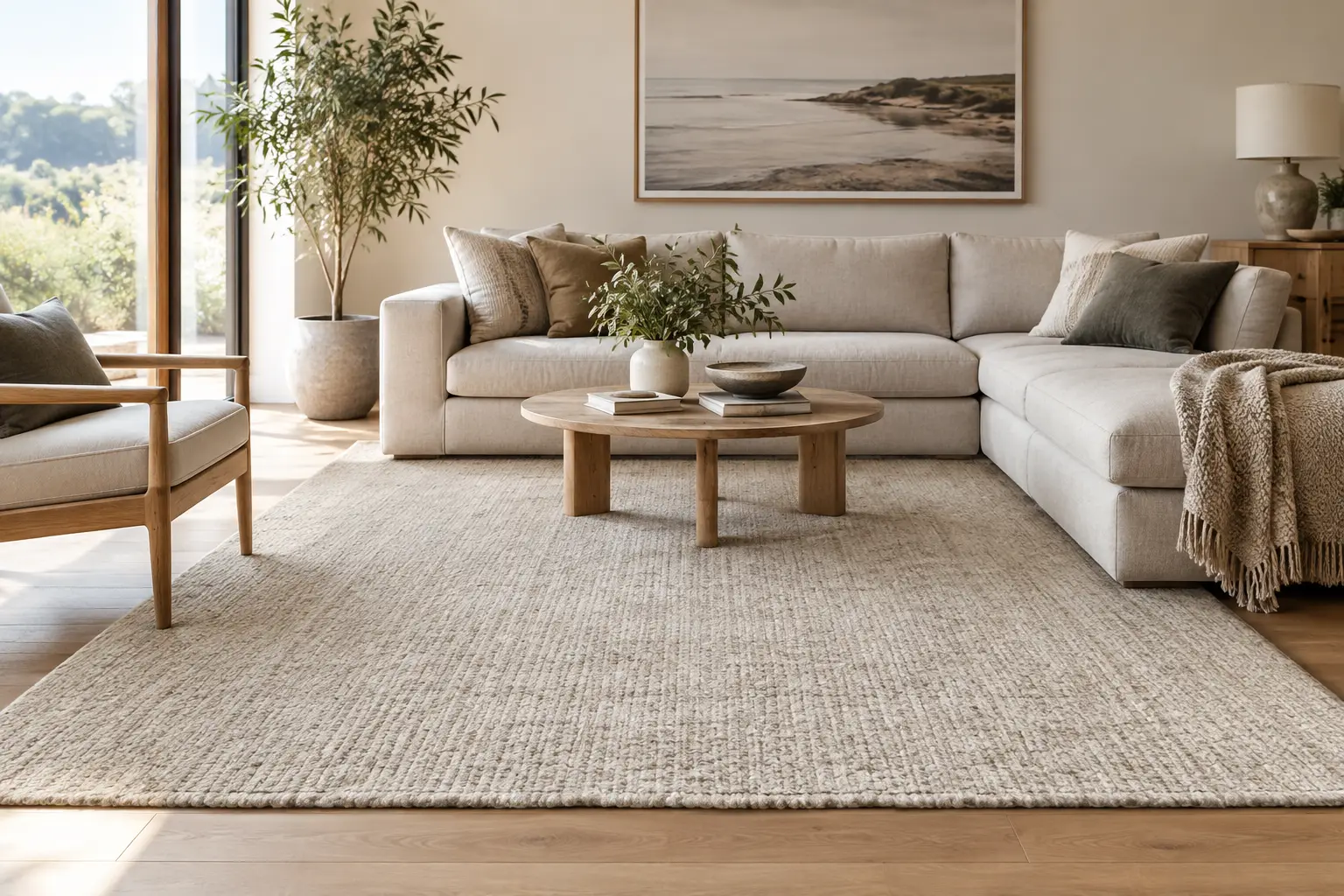
A neutral rug can be the element that makes a room feel resolved rather than merely furnished. Neutral wool rugs do more than fill an empty area of floor: they ground a seating arrangement, soften timber or tile, and give open-plan rooms a clearer sense of purpose. The right one introduces warmth and texture without asking the rest of the room to compete.
Neutral does not have to mean flat, pale or predictable. In a well-considered interior, the quietest colours often carry the most visual weight. An oat, stone, taupe or muted charcoal rug can hold together a mix of timber, linen, upholstery and art while leaving room for the character of the home to show through.
Why neutral wool rugs work in considered interiors
A neutral palette makes it easier to see proportion, materiality and light. This is especially useful in Australian homes, where hard finishes are common and daylight can shift sharply between a bright coastal morning and a warm late-afternoon room. A wool rug adds a tactile layer underfoot, giving a tiled living space or timber-floored apartment more softness and visual calm.
The appeal is not that a neutral rug disappears. It is that it can be present without becoming prescriptive. Broad, quiet curves, a subtle border, a low-contrast grid or a gently irregular surface can bring sculptural interest to a room that already has plenty going on. Rather than introducing another strong colour or busy motif, the rug gives furniture a composed setting.
This flexibility also matters when a home changes. A sofa may be reupholstered, artwork may move, or a spare room may become a nursery, study or guest room. Warm-neutral tones tend to accommodate those shifts more easily than a highly specific colour scheme. That said, a neutral rug still needs enough depth to suit its surroundings. In a room with cream walls, pale upholstery and light oak, an ivory rug may feel calm and airy, or it may cause the entire space to lose definition. The difference lies in contrast and texture.
Choose the undertone before the shade
The most useful way to choose a neutral is to look beyond the name of the colour. Beige, ivory, grey and stone can each lean warm, cool, pink, yellow, green or brown. A rug that looks softly taupe on a screen may read quite differently beside your flooring and in your home’s natural light.
Start with the fixed elements you are not planning to change. Look at the undertone in the floorboards, stone benchtop, tiles, curtains and largest upholstered piece. Honey-toned oak, travertine, warm white walls and tan leather usually sit comfortably with oat, sand, mushroom and clay-based neutrals. Charcoal joinery, polished concrete and blue-grey sofas may call for stone, greige or a muted charcoal rather than a yellow-leaning cream.
A useful rule is to create gentle separation between the rug and the floor. On pale oak or light tiles, choose a rug with enough tonal depth, texture or border detail that its outline remains visible. On dark timber, a lighter wool rug can lift the centre of the room and reduce the visual heaviness under a large sofa. You do not need dramatic contrast, but you do want each surface to have its own role.
Samples and product images are valuable starting points, though they should be viewed with the practical reality of light in mind. Place a sample, where available, near the intended area and check it in morning light, afternoon light and artificial evening light. This is particularly worthwhile in rooms that open to a balcony, garden or covered alfresco area, where reflected light can alter how a neutral reads.
Let texture do some of the work
When the palette is restrained, texture becomes more noticeable. A dense, even surface feels different visually from a looped texture, a carved line or a design with raised and lower areas. These details create shadow and movement without introducing a loud pattern.
Consider the other tactile elements in the room. If you have a bouclé armchair, heavily grained timber table and woven curtains, a quieter rug surface may bring balance. If the furniture is smooth-lined and the finishes are clean - plaster walls, leather, painted joinery or stone - a more textural wool rug can stop the room from feeling overly polished. The goal is not to match every texture, but to distribute visual weight with intention.
Size is what gives a rug authority
Many rooms feel unsettled not because the rug colour is wrong, but because the rug is too small. A rug should relate to the furniture it serves. In a living room, it is usually more convincing when at least the front legs of the sofa and chairs sit on the rug. This connects the pieces into one seating zone instead of leaving them floating around a small central rectangle.
For a typical living area, a 2 m x 3 m rug can suit a compact apartment arrangement or a smaller lounge with a two- or three-seat sofa. A 2.5 m x 3.5 m rug often gives a standard family living room more generous coverage. Larger open-plan spaces may need 3 m x 4 m, particularly where the rug is expected to contain a sectional sofa, occasional chairs and a coffee table.
There is no need for a rug to reach every wall. Leaving approximately 20 to 45 cm of visible flooring around its edge usually gives the arrangement breathing room, though narrower clearances can be appropriate in compact rooms. Measure the furniture grouping rather than the whole room, then mark out the likely rug size with masking tape. It is a simple way to assess circulation before committing.
In an open-plan home, separate rugs can create distinct zones without adding walls. One can anchor the living area while another sits beneath the dining table or defines a reading corner. Choose designs that share an undertone or level of visual restraint rather than selecting identical rugs. Repetition can make the space feel staged; a quiet relationship between pieces feels more natural.
Placement for living, dining and bedrooms
In a living room, centre the rug on the conversation area rather than the architecture alone. If the sofa faces a television wall but the room opens towards dining, align the rug with the seating arrangement so it clearly signals where the lounge begins.
Under a dining table, the rug should extend beyond the table far enough for chairs to remain on it when pulled back. As a guide, allow around 60 cm beyond each side of the table. This is often the difference between a dining setting that feels comfortably grounded and one where chair legs catch at the rug edge during everyday use.
For a bedroom, position matters as much as size. A larger rug placed under the lower two-thirds of the bed can extend beyond both sides and the foot, creating warmth where you step out in the morning. In a smaller room, runners on either side can be a sensible alternative, especially when a large rug would sit awkwardly against wardrobes or doors. The choice depends on whether you want the rug to anchor the bed as a whole or simply soften the floor at key points.
Living with wool in a real home
A rug should suit the rhythm of the room, not just the photograph. Before choosing, consider how people move through the space, whether dining happens at the table every night, how often doors open to the garden, and whether the room receives direct sun. A light neutral can feel expansive in a low-traffic bedroom, while a deeper taupe, brown-based stone or muted charcoal may make more sense where daily life is concentrated.
Care also begins with placement. Use the appropriate underlay for your floor type and rug, follow the care guidance supplied for the specific piece, and attend to spills promptly according to those instructions. Regular, gentle vacuuming suited to the rug’s construction helps keep the surface looking considered. Avoid assuming that every wool rug should be treated in exactly the same way: pile height, texture and construction all influence the appropriate routine.
If your room needs warmth but not another dominant feature, a neutral wool rug is often the most effective place to begin. Choose one with the right undertone, generous proportion and enough textural presence to hold the room quietly. It will not just soften the floor. It can make the way the whole space sits together feel more deliberate, liveable and at ease.