
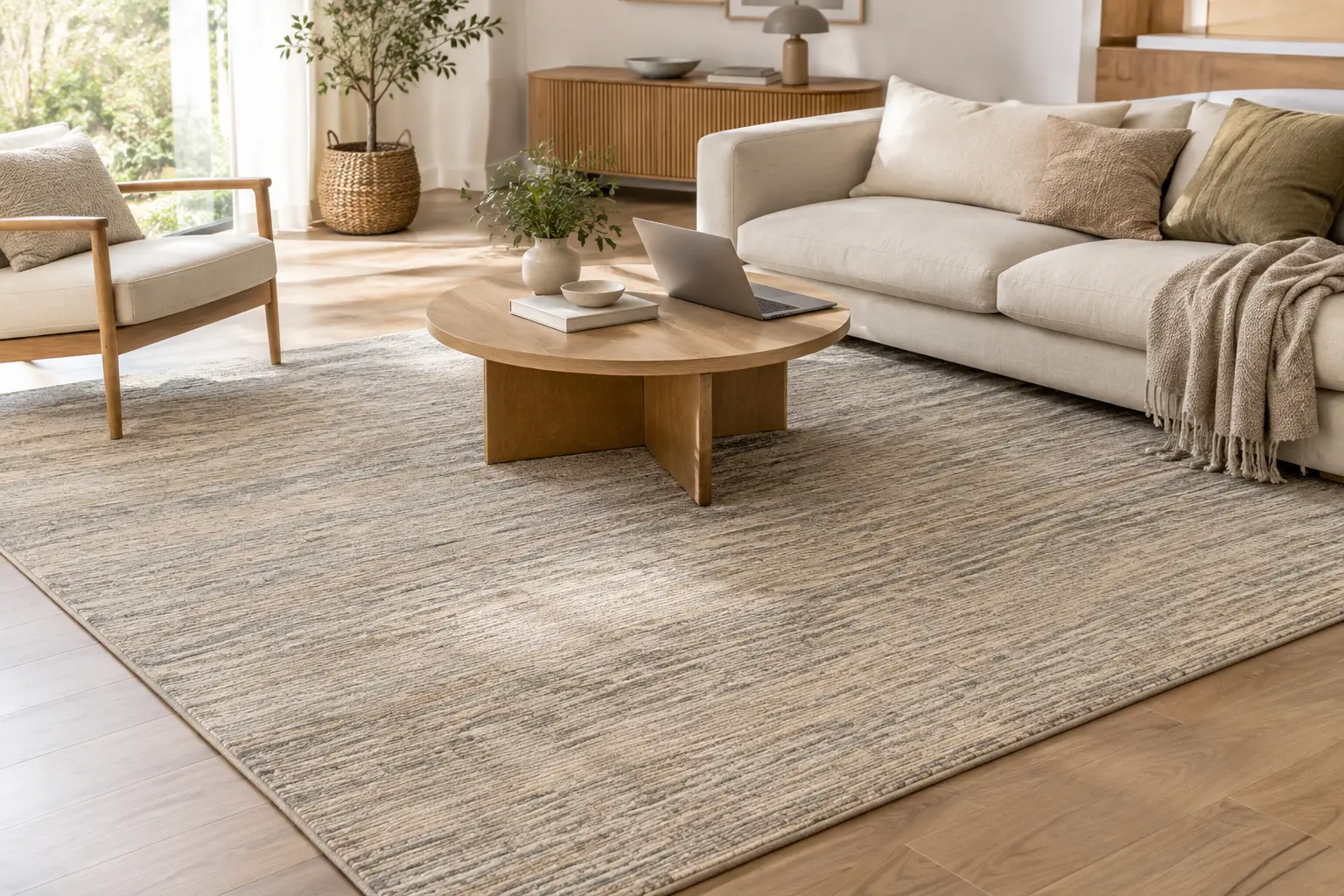
A rug can look quietly right on a screen, then feel unexpectedly small, cool or visually heavy once it reaches the room. That gap is why an online rug buying review should be less about chasing the most photogenic option and more about reading the details that determine how a rug will live in your home: proportion, pile, colour, materiality and placement.
Buying online gives you time to compare without the pressure of a showroom visit. It also asks you to make a few decisions before you can feel the texture underfoot or see the colour in your own light. The most reliable approach is to assess the room first, then use product imagery and specifications to narrow the choice. A considered rug does not simply fill bare floor. It grounds furniture, softens hard finishes and gives the room a clearer centre.
Online rug buying review: begin with scale
Most disappointing online rug purchases are a proportion issue rather than a style issue. A small rug can make even well-chosen furniture appear scattered, particularly in open-plan living areas where the floor has a lot of visual presence. Before looking at colour or pattern, measure the zone the rug needs to define.
In a living room, a rug should usually sit beneath at least the front legs of the sofa and occasional chairs. This creates a connected seating arrangement rather than a collection of separate pieces. As a guide, allow the rug to extend around 15 to 30 cm beyond each side of the sofa where room dimensions permit. A 200 x 300 cm rug often works in a compact apartment living area, while 250 x 350 cm or larger can bring better balance to a generous family room.
There are exceptions. A smaller rug may suit a reading corner with one chair and a side table, or a narrow sitting room where a larger size would press too closely against every wall. The key is intentionality. Leave a visible border of flooring around the rug, but avoid a scale that leaves the sofa floating beyond its edges.
For dining rooms, measure the table at its fullest everyday setting, then add approximately 60 cm on all sides. Dining chairs should remain on the rug when pulled back. This matters on timber or tiled floors, where a chair catching the rug edge can make the arrangement feel awkward in daily use.
Bedrooms benefit from the same thinking. A rug placed under the lower two-thirds of a queen or king bed should extend beyond both sides, creating warmth where feet meet the floor. In a smaller room, runners on either side of the bed can be more proportionate than forcing one large rug into a tight footprint.
Make a full-size floor outline
Use painter's tape, newspaper or sheets of kraft paper to mark your proposed dimensions on the floor. Walk around it, open drawers, pull out dining chairs and notice where it meets door swings. This simple test reveals more than a styled image can, especially in townhouses and apartments where circulation space is limited.
It also helps clarify visual weight. A broad rug in a pale, low-contrast tone can occupy a substantial footprint without making a room feel crowded. A darker, more graphic design may need a little more breathing room around it.
Read colour through your home, not your screen
Screens can make warm neutrals look cooler or flatter than they are. Photography is useful for understanding the overall direction of a design, but your existing finishes should guide the final decision. Look at the undertones in your walls, sofa, curtains, flooring and larger timber pieces.
An ivory or oat rug can bring lightness to a room with deep timber and charcoal upholstery. Sand, taupe and stone tones often create a composed connection between cream upholstery, pale oak and travertine-like finishes. Clay and muted brown can add needed depth to a room that is otherwise very pale, without introducing a loud contrast.
Do not assume beige and grey are incompatible. The question is whether each leans warm or cool. A cool blue-grey sofa paired with a distinctly golden rug can feel unresolved, while a soft greige or mushroom-toned rug may bridge both elements. In homes with warm afternoon light, especially coastal or west-facing rooms, subdued tones can appear richer later in the day. In a shaded urban apartment, a slightly warmer rug may prevent the room from feeling austere.
Look closely at whether a rug uses one flat shade or several related tones. Tonal variation is often more forgiving in everyday spaces because it gives the surface movement without becoming busy. It can also make crumbs, lint and the ordinary marks of living less visually prominent than a very uniform field of colour, though care requirements should always be checked for the specific rug.
Understand texture and construction from the listing
Texture changes how a rug reads at a distance and how it feels in use. A low, dense surface tends to look more tailored and can suit a dining area or a room with clean-lined furniture. A deeper, more tactile pile introduces softness and shadow, which can balance streamlined cabinetry, stone, tile and polished concrete.
Online images should show more than one styled room photograph. Seek close-up views that reveal the yarn, surface variation and edge finish. A straight-on image is helpful for colour, while angled images reveal pile direction, relief and sculptural detail. If a rug features loops, cut pile, raised lines or a carved pattern, these elements will create changing light across the surface. That movement can be subtle and calming, but it may look different from one side of the room to the other.
Material descriptions deserve the same attention as the design. Wool is valued for its natural texture, warmth and ability to bring softness to hard-floored rooms. Its appearance can evolve with use, and some new wool rugs may shed initially. This is not necessarily a fault, but it is worth understanding before placing a rug in a high-visibility space. Read the care guidance, cleaning recommendations and construction details rather than relying on a broad material label alone.
Consider your household honestly. A high-pile rug may feel inviting in a quiet bedroom but be less practical beneath frequently moved dining chairs. A textural surface can give a restrained room more character, while a flatter weave may better suit a busy path between kitchen and living space. There is no universally right choice - only a better fit for the way the room is used.
Check the details that sit outside the photograph
A thoughtful online rug buying review includes the less glamorous information: exact dimensions, tolerance notes, pile height, fibre content, care instructions and the terms that apply if the rug is not right for your space. Compare the listed size to your taped-out floor plan, not to your estimate of what “large” means.
Also consider access before ordering. Measure narrow hallways, stair landings and lifts in apartment buildings, particularly when choosing a large rug. A rolled rug is easier to manage than a rigid furnishing, but size and weight still affect delivery day. Plan where it will be unrolled, and give it time to settle flat after arrival if needed.
If you are choosing for an open-plan room, treat the rug as a boundary rather than an isolated decorative piece. One rug can anchor the lounge zone, while a second design in a related but not identical tone can define the dining area. Matching every surface exactly can feel overly coordinated. A shared warm-neutral palette, similar visual weight or a repeated textural note is usually enough to make the spaces feel connected.
Give yourself a clearer decision framework
Save the product images alongside photographs of your own room taken in natural daylight. Then ask a practical question: does this rug support what the room already needs? Perhaps the answer is softness underfoot, a larger visual anchor, a quiet layer beneath sculptural furniture or a tonal bridge between timber flooring and upholstery.
CEVORI approaches rugs as architectural layers for this reason. The right design does not compete with a home’s character. It gives furniture a grounded place to sit, brings a little calm to open space and makes everyday rooms feel more resolved. When scale, colour and texture are considered together, buying a rug online becomes a measured decision rather than a leap of faith.