
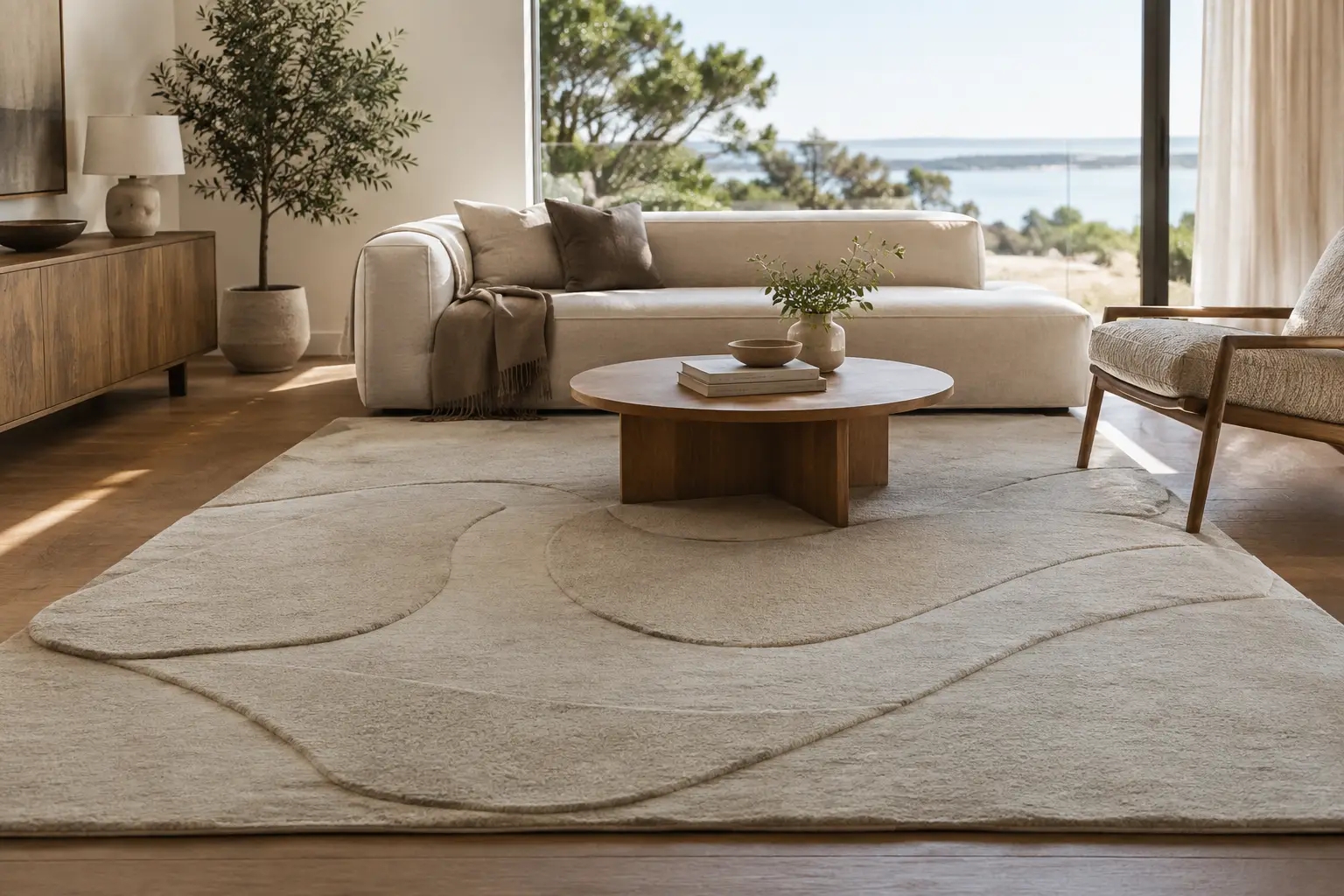
A sculptural rug can do more than soften a timber or tiled floor. In Australian homes, where open-plan layouts and hard finishes are common, sculptural rugs in Australia offer a quiet way to create definition, warmth and visual calm without relying on loud pattern or excess furniture.
The right piece acts as an architectural layer. It gives a sofa somewhere to belong, brings a dining setting into proportion, or makes a bedroom feel settled from the floor up. Its impact comes from relief, line and materiality rather than colour alone - broad curves, a carved border, a tonal grid or a raised fold that catches the changing light.
What makes a rug sculptural?
A sculptural rug has dimension. Rather than presenting one flat, uniform surface, it uses texture, cut-pile variation, carved lines or considered geometry to create a sense of depth. The effect may be subtle: a low-relief curve visible only when afternoon light moves across the floor, or a border that frames the centre of the room without forming a hard edge.
This is different from a busy patterned rug. Pattern asks to be read from a distance. Sculptural texture is often felt before it is noticed. It creates interest close up, adds movement to a restrained palette and helps a room feel layered without becoming visually crowded.
That distinction suits homes built around timber, stone, linen, plaster, ceramics and soft upholstery. In a room with pale oak boards, cream seating and warm-white walls, a flat ivory rug can sometimes disappear. An ivory rug with a tonal linear surface or a quiet curved motif still feels composed, but gives the floor a little more visual weight.
Why sculptural rugs work in Australian homes
Many Australian interiors receive strong natural light, particularly in coastal homes, new builds with generous glazing and apartments facing an open aspect. Textural surfaces respond well to this light. They reveal shadow and movement through the day, lending depth to a neutral room without introducing another strong colour.
They also balance the hard finishes that make everyday living practical. Polished concrete, porcelain tile and timber floors are easy to live with, yet they can make a large room feel acoustically and visually sparse. A rug softens that expanse and helps a seating area feel more human in scale.
In an open-plan kitchen, dining and living room, sculptural detail can define a zone without closing it off. A warm-neutral rug beneath the sofa creates a clear living area, while its restrained surface keeps the whole plan connected to the dining space. This is particularly useful when you want separate functions but do not want the visual interruption of several competing patterns.
Start with proportion, not texture
Texture should support the room’s layout, not distract from it. Before deciding between a curved motif, subtle grid or border, establish the size that gives your furniture a grounded arrangement.
In the living room
For most living rooms, aim for the rug to sit under at least the front legs of the sofa and occasional chairs. This connects the furniture into one composition. A rug that sits entirely in the middle, surrounded by a wide strip of bare floor, can make even well-chosen furniture appear to float apart.
In a compact apartment, a 160 x 230 cm rug may suit a small two-seat sofa and a single chair. For a more typical three-seat sofa arrangement, 200 x 300 cm is often a more balanced starting point. Larger rooms may need 250 x 350 cm or more, especially when the seating is pulled away from the walls.
The shape of the sculptural detail matters here. Long, directional lines can reinforce the length of a room. Broad curves can soften a square layout or the straight edges of a modular sofa. A border can bring order to a generous rug size, framing the seating area while leaving the central surface calm.
In the bedroom
A sculptural rug works well in bedrooms because it makes the first step out of bed feel intentional. For a queen bed, a 200 x 300 cm rug placed horizontally under the lower two-thirds of the bed will usually extend beyond both sides and the foot. For a king bed, 250 x 350 cm often gives more generous coverage.
If a full-size rug is not practical, two runners placed on either side can provide softness underfoot. This approach leaves more of the floor visible, which can suit a smaller bedroom, though it will not create the same unified visual foundation as one larger piece.
Keep the design calm near upholstered bedheads, layered bedding and bedside tables. A low-contrast sculptural surface is generally more restful than a highly graphic pattern, particularly in rooms with changing morning light.
Under a dining table
Dining rooms need practical clearance. The rug should extend at least 60 cm beyond the table edge on all sides so chairs remain on the rug when pulled back. Measure from the chair in use, not only from the tabletop.
Sculptural texture can add welcome softness to a dining zone, but very pronounced raised elements may be less suited to chairs that move often. A quieter relief or tonal border is usually easier to live with while still bringing shape and material interest to the setting.
Choose colour by undertone
Sculptural rugs do not need to be high contrast to have presence. In fact, their strength is often their ability to hold a room together through tonal variation: oat against ivory, stone against soft grey, or clay against muted brown.
Look first at the undertones already in your home. Cream walls can lean yellow, pink or grey. Timber may be honeyed, walnut-toned or pale and neutral. A rug in a cool blue-grey can make warm oak look more orange by comparison, while a sand or taupe ground usually creates a more balanced relationship.
For beige sofas, choose a rug that is either slightly lighter or noticeably deeper rather than an almost identical beige. Enough contrast is needed to show the rug’s form. With charcoal or deep brown upholstery, an ivory, oat or stone rug can lighten the furniture grouping without making it feel stark. In rooms with grey tile or concrete, a clay, taupe or soft brown note can introduce warmth and keep the scheme from feeling overly cool.
Bring home samples where possible and look at them in morning, midday and evening light. A colour that seems quietly neutral on a screen can read quite differently beside your flooring, particularly in a room with strong western sun.
Consider the room’s everyday rhythm
A considered rug choice accounts for how the room is actually used. A formal sitting room has different requirements from the space beside the kitchen where school bags, cups and people move through all day. Sculptural surfaces vary in their depth and construction, so review the specific product’s material and care guidance before deciding where it will live.
For busy areas, a restrained pattern or tonal texture can be useful because it gives the eye more than one flat surface to focus on. That does not remove the need for regular care. Attend to spills promptly, use appropriate cleaning methods for the rug’s construction, and avoid assuming that any particular fibre or finish will suit every household.
A rug underlay can also be a practical consideration. It can help the rug sit more securely and reduce shifting on smooth floors, while adding a little extra cushioning. Check that the rug and underlay combination works with your flooring and does not create an awkward lip at doorways.
Let the rug lead, then edit around it
When the rug carries sculptural detail, the surrounding room benefits from restraint. This does not mean everything must match. It means choosing a few materials that speak to one another: a timber coffee table with rounded edges, linen curtains, a ceramic lamp or a textured cushion in a related earth tone.
Avoid repeating every line in the rug elsewhere. If the rug has broad, quiet curves, a curved occasional chair or round coffee table may be enough. If it has a grid-like surface, soften the room with upholstery, drapery or organic ceramics. The goal is a composed mix of structure and ease, not a theme.
CEVORI approaches rugs as part of the room’s architecture rather than an afterthought. When scale, tonal colour and texture are working together, a sculptural rug gives everyday spaces a settled feeling - one that remains calm whether the room is fully styled or simply being lived in.