
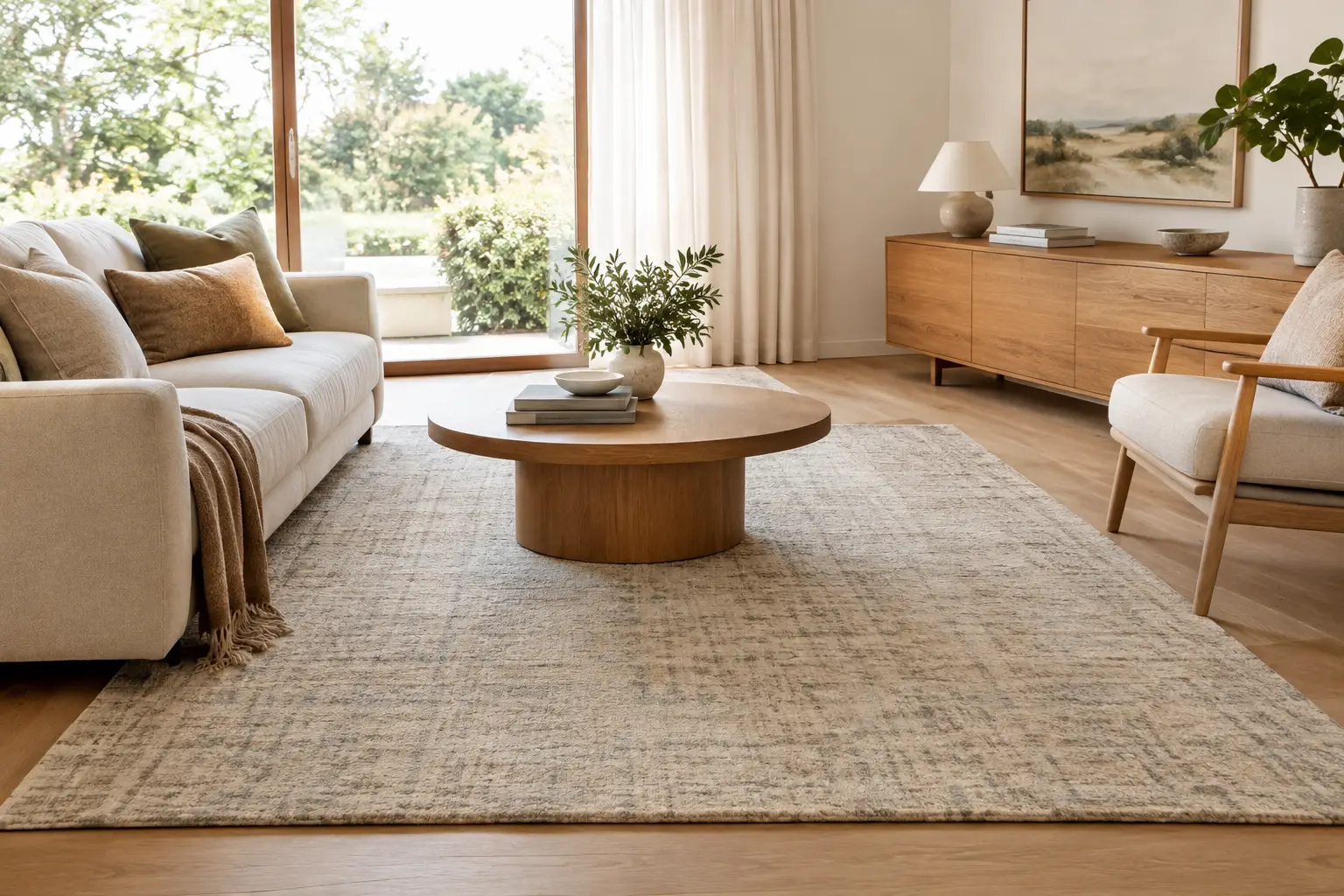
A room can have all the right pieces - a comfortable sofa, warm timber, considered lighting - and still feel slightly disconnected. Often, the missing layer is not more colour or decoration, but a rug with enough presence to gather everything into a composed whole. Subtle pattern rugs do this particularly well. They introduce movement, texture and visual structure without asking to be the loudest element in the room.
For homes built around warm neutrals, natural materials and relaxed everyday living, restrained pattern is often more useful than a plain surface or a bold statement print. It gives the eye somewhere to rest while allowing furniture, art and architecture to retain their place.
What makes a subtle pattern rug work?
A subtle pattern is not simply a pale pattern. It is one where contrast, scale and repetition are carefully balanced. Think soft grids, faded borders, broad quiet curves, sculptural folds, broken stripes or abstract marks in closely related tones. From across the room, the rug may read as a calm field of colour. Up close, its surface reveals depth and detail.
This is what makes it so adaptable. A high-contrast geometric can quickly become the focal point of a room, which may be exactly right in a pared-back space. But in a home with timber joinery, linen curtains, textured upholstery and collected objects, a quieter design can bring order without adding visual competition.
Subtle pattern also has a practical role. On an entirely plain rug, shifting pile direction, everyday dust or a small spill can be more immediately visible depending on the colour and material. A tonal design creates gentle variation across the surface. That does not remove the need for care, but it can make a lived-in room feel less visually exacting between cleans.
Choose pattern by the room's visual weight
The right rug is less about following a fixed rule and more about noticing what the room already asks of the eye. Pattern should respond to the visual weight of the furniture, floor and surrounding finishes.
In a calm, layered living room
If your living room has a low-profile sofa, soft upholstery and warm-neutral walls, look for a pattern with movement rather than a defined motif. An oat, stone or taupe rug with a gently irregular line can stop the room from feeling flat while keeping its relaxed character. This is especially effective where the sofa and rug are similar in tone: the pattern creates separation without creating a hard edge.
In a room with a more sculptural sofa, curved occasional chairs or strong stone surfaces, a restrained grid or border can provide a useful counterpoint. The contrast is in form rather than colour, which keeps the overall scheme balanced.
In open-plan spaces
Open-plan homes often need clearer zones, particularly where living, dining and kitchen areas share the same flooring. A subtly patterned rug can define the seating area without creating a visual break as strong as a dark or heavily patterned design.
Let the rug be generous enough to anchor the furniture. In most living rooms, aim for at least the front legs of the sofa and chairs to sit on it. A rug around 200 x 300 cm can suit a compact seating zone, while 250 x 350 cm or 300 x 400 cm may make more sense in a larger family room. The exact size depends on the furniture footprint, but going too small is the more common mistake. A small rug makes a room feel as though the furniture is hovering around it rather than belonging together.
Where the living area opens to a deck, courtyard or balcony, a tonal pattern can be particularly effective. It softens the transition from hard flooring and glass while sitting comfortably alongside the changing light of an Australian afternoon.
Under a dining table
A dining rug benefits from pattern that is present but not busy. Chair legs move, meals are shared, and the table itself often obscures much of the design, so a large-scale, low-contrast motif usually reads better than a small intricate repeat.
Measure from the outer edge of the table and allow roughly 60 to 75 cm on each side, so chairs remain on the rug when pulled back. In a smaller dining nook, this proportion matters more than choosing a showy design. A well-sized, quiet rug gives the area definition and warmth underfoot without making it feel crowded.
Match the colour to your undertones, not just your palette
Many interiors are described simply as beige, grey or white, but the undertones are what decide whether a rug feels settled. A cream sofa may lean yellow, pink, olive or cool grey. Timber can be honeyed, red-toned or muted and pale. The same ivory rug will look very different beside each one.
For a room with oak, walnut, travertine, terracotta or warm white walls, consider rugs in sand, mushroom, clay, oat and brown-based stone. These colours tend to connect the room’s materiality rather than sit apart from it. Charcoal accents can add definition, but a softened charcoal often feels more liveable than a sharp black-and-white contrast.
If your home has cooler grey flooring or white-painted joinery, you do not need to match the coolness exactly. A rug with a warm-neutral base can prevent the room from feeling stark, provided its pattern includes a little grey, taupe or muted charcoal to create a bridge. The aim is tonal conversation, not exact colour matching.
Before deciding, view samples or imagery in the room at different times of day where possible. Coastal light can make pale colours appear cleaner and cooler, while shaded urban rooms may draw out warmth and depth. Evening lighting also changes how contrast appears. A pattern that seems barely there in daylight may become more defined once lamps are on.
Scale matters as much as the pattern itself
The smaller the pattern, the more active it can appear. Fine repeated motifs may suit a compact room with simple furniture, but they can create visual noise in a larger living area or alongside heavily textured upholstery. Broad shapes and open spacing generally feel quieter, even when the pattern covers the full surface.
Consider the room from the doorway. If the rug is the first thing you notice, ask whether that is intentional. In a restrained interior, the better result is often that you notice the room feels grounded first, then see the rug’s detail as you move through it.
This is also why a border can be so effective. A soft border gives a rug an architectural edge and helps contain a seating arrangement, yet leaves the centre calm. It can bring useful structure to apartments and townhouses where the living area needs to perform several roles without feeling over-furnished.
Material and texture change the reading of pattern
Pattern is not only printed or woven through colour. It can be created through raised and lower pile, looped surfaces, carved lines or shifts in sheen. These textural approaches are especially appealing in rooms where the palette is intentionally narrow, because they add dimension without introducing another strong colour.
For everyday spaces, material choice should be considered alongside appearance. Wool rugs are valued for their warmth, texture and natural variation, but every rug has its own construction and care requirements. Check the product details for the specific material, pile and recommended cleaning approach, then consider the room’s use honestly. A formal sitting room, a busy family zone and a dining space place different demands on a surface.
Texture also affects how a rug sits with the rest of the room. A more tactile finish can soften tiled floors and streamlined cabinetry. A flatter weave or lower profile may suit spaces where doors need to clear the rug or where you want dining chairs to move more easily. Neither is inherently better - proportion, placement and daily use should lead the decision.
Give the room time to settle around it
A subtle rug may not deliver the immediate jolt of a strong print. Its value is slower and more lasting: it makes the sofa feel more intentional, gives a timber floor warmth, and helps a collection of furniture feel like one room rather than separate purchases.
When choosing, resist the urge to fill every surface with contrast. Let the rug carry a quiet layer of movement, then allow the room’s forms, materials and light to do the rest. A considered pattern has room to live with you as cushions change, art is rearranged and the home gradually becomes more your own.